
Practical AI Search Optimisation for NZ Retailers
Retail SEO and AEO (Answer Engine Optimisation) are key to getting your store noticed by customers in the age of AI search. Gone are the days when people simply “Google” products – now they often ask questions directly to AI assistants and voice search devices. For Kiwi retailers, this means your website must speak a clear, concise language that both people and AI can understand. In this article, you'll learn what Retail SEO and AEO mean, why AI-driven search matters, and how to optimise your site so it appears in both traditional search results and AI-powered answers.
What is Retail SEO and AEO?
Retail SEO (Search Engine Optimisation) means making your online store easy to find on search engines like Google. It involves using keywords, quality content and a good site structure so that people searching for products see your store in the results. Answer Engine Optimisation (AEO) is a newer idea: it’s about making your content the exact answer that an AI-driven tool gives. While SEO focuses on ranking pages, AEO focuses on being cited as the direct answer to a customer’s question.
AEO is about tailoring your content to questions customers ask. Instead of writing only for clicks, you write content so that answer engines (like ChatGPT, Google’s AI Overviews or voice assistants) can pick it up and present it. This often means using question headings, FAQ sections and concise answers up front. That way an AI is more likely to quote your information in its response. Good SEO and AEO overlap: a solid SEO base (fast site, mobile-friendly, well-written content) makes a great foundation for adding AEO tactics.
AEO and GEO: What About Generative Engine Optimisation?
You may have also come across the term GEO — generative engine optimisation. This refers specifically to optimising for generative AI tools: the ones that produce original text, like ChatGPT or Google's Gemini. GEO is sometimes used interchangeably with AEO, but the two are closely related rather than identical.
Think of it this way: AEO is the broader category (optimising for any answer engine), while GEO specifically targets generative AI systems that create new content in response to queries. For NZ retailers, AEO and GEO are both worth thinking about, since your customers are increasingly using generative AI to research purchases before they buy.
Why Retail Businesses in NZ Need to Embrace AEO Now
|
📊 Adobe Analytics reported a 3,500% increase in AI-driven retail site traffic in 2024. 🤖 Kiwi shoppers are using AI assistants and voice search to research products before buying. 🔍 AI Overviews often answer queries on the results page — being cited matters as much as ranking. |
New Zealand shoppers are no different from the global trend. More Kiwis are using voice search, AI assistants, and generative AI tools to research products, compare prices, and find local retailers. When a customer asks an AI "where can I buy a good espresso machine in Auckland?", the AI draws on content it has parsed, understood, and deemed trustworthy.
Beyond traffic, there's a zero-click reality to contend with. AI Overviews in Google often answer a query right on the results page — meaning a customer may never visit your site at all. Being featured in that answer (with your brand cited) is the next best thing to a click. It builds awareness, trust, and brand recognition even when no one taps through.
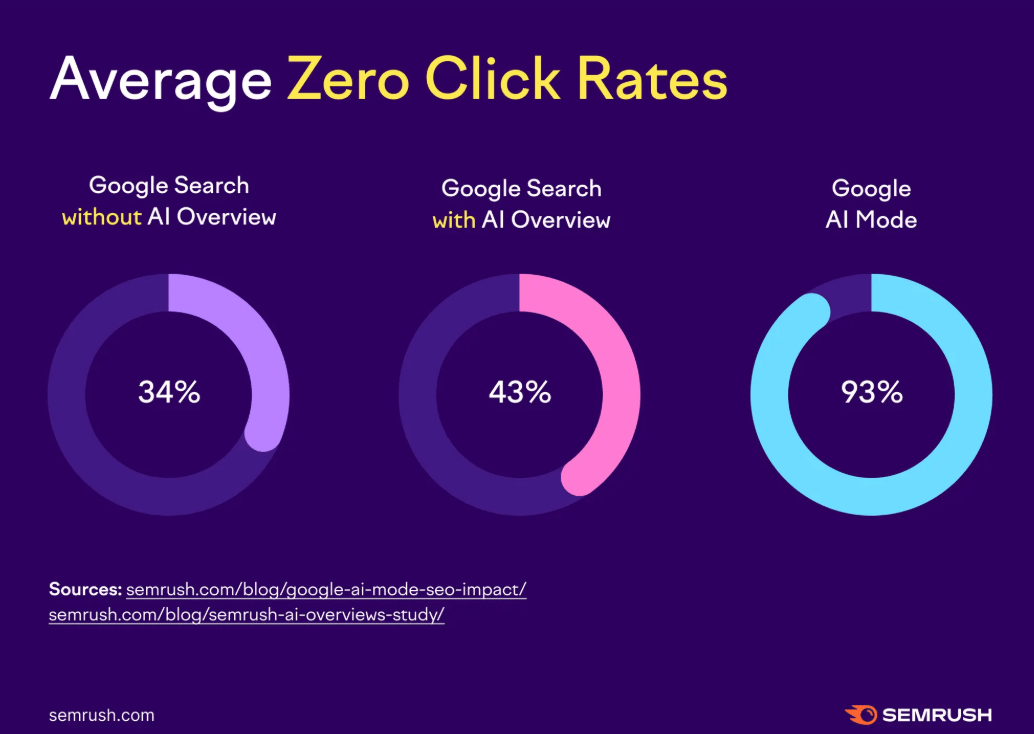
According to SEMRUSH, 93% of consumers using AI Mode simply don't click through to any website.
How AI-Powered Search is Changing Retail
AI search is like asking a well-informed friend for advice instead of browsing websites. Many Kiwis now use chatbots and voice assistants to find products and information. In fact, nearly half of New Zealanders have tried ChatGPT or a similar AI assistant when researching something. Customers now ask full questions like “What’s the best hiking boot shop in Wellington?” instead of just typing keywords. This shift matters because if your site isn’t part of those AI answers, you risk losing visibility to potential customers.
AI models like the ones behind ChatGPT and Google’s Gemini rely on web content to generate answers. They use crawlers (for example, GPTBot, Googlebot, etc.) to index and learn from websites. The AI’s answers often show at the top of search results as direct answers or summaries, which means more zero-click searches. Today, more than half of Google searches end without a click because the answer is given right on the page. Gartner even predicts that by 2026, about 25% of organic search traffic will come through AI chatbots and virtual assistants.
For retailers, this is both a challenge and an opportunity. The challenge is that big global brands have vast resources and advanced AI, but the opportunity is that NZ retailers can compete with local insight. You have local knowledge and agility: AI answers value local context. For example, 97% of Kiwis still use Google as their main search engine, but about 48% already use voice or chatbot methods. Nearly half of respondents in one Kiwi study said they used an AI chatbot for search at least once. This shows many shoppers are open to AI answers. AI systems reward clear, helpful, local information – exactly the kind of detail NZ retailers can provide.
How Do Customers Find NZ Stores with AI?
In practice, customers might find your store through AI in several ways:
- Local business listings: If someone asks an AI for “best wool socks Christchurch,” the AI will look at sources like Google and Yelp. A claimed, up-to-date Google Business Profile (and Bing Places) is crucial. ChatGPT often pulls data from trusted listings. Make sure your profile includes the right address, phone, hours, and services. In one example, ChatGPT was shown using data from a company’s Google Business Profile and Yelp to recommend a local shop.
- Customer reviews: High ratings matter to AI. AI assistants often highlight places that are “highly rated”. Encourage satisfied customers to leave Google or local reviews for your store. A retailer with many five-star reviews is far more likely to be suggested than one with only a few mediocre ones. Reviews act as quality signals that AI systems trust.
- Voice and visual search: Many Kiwis use voice (“Hey Google…”) or image search. About 48% use voice search regularly and 33% have used image search. To capture voice traffic, use natural, conversational phrases and include location terms (like “near me” or a city name). For visual search, use clear product photos with descriptive alt text, so the AI can match images with what customers are looking for.
- Local directories: AI can also check local directories (Yellow Pages, Finda, Localist, etc.) for your information. It looks for consistency. If one site lists your address one way and another site lists it differently, that can confuse the AI. Make sure your Name, Address and Phone (NAP) are exactly the same everywhere. For example, ChatGPT has indicated it pulls from sources like Google, Yelp, TripAdvisor (a “vast directory network” of info). It will notice if one listing says “Queen St.” and another says “Queen Street.” A consistency audit helps ensure AI sees your business as trustworthy.
By covering these areas – good listings, positive reviews, clear images and consistent info – you make it more likely that AI assistants will find and trust your retail brand when New Zealanders search.
How AI Search Actually Works — and What It Means for Your Content
AI answer engines use natural language processing to understand the intent behind a question, not just the literal words. They look for content that directly addresses a query in plain, clear language, then assess the quality and trustworthiness of the source — favouring authoritative, well-structured, and up-to-date content.
A few key factors influence whether your content gets picked up:
- Relevance and semantic matching — AI models look for content that covers the concepts and subtopics within a query. Writing comprehensively about a subject, rather than stuffing in exact-match keywords, is what earns you a spot.
- Structured data and machine-readability — Schema markup makes it far easier for AI to identify and excerpt your content accurately.
- Authoritativeness and trust signals — AI systems lean on trusted sources. Brands mentioned widely online tend to be featured more often.
- Freshness — AI tools connected to real-time search favour current content. An article from this year generally outperforms an outdated one.
- Content format — Bullet points, numbered steps, clear headings, and direct definitions all help AI parse and quote your content accurately.
Key Steps to Optimise Your Retail Website for SEO and AEO
Here’s a checklist of practical steps to improve both traditional SEO and AI visibility:
- Answer customers’ questions: Identify common shopper queries (e.g. “How do I return an online order?” or “Do you offer layby?”) and answer them clearly on your site. Start each section with the answer and then add details. AI search favours content that directly satisfies a query. For instance, a “Shipping & Returns” page that immediately states “Yes, we offer free returns” is likely to be picked up by an AI answer.
- Use descriptive headings and lists: Structure your content with clear H2/H3 headings. For example, “Steps to Optimise Product Listings for AI Search” signals what follows. Within sections, use bullet or numbered lists for key points. AI models scan for self-contained facts in headings or lists. This makes it easy for search engines or chatbots to pull the relevant bits. Example list:
- Identify customer questions using tools like Google’s People Also Ask or AnswerThePublic.
- Put the main answer first (40–60 words) at the top of the section.
- Include a dedicated FAQ section on key pages with brief Q&A.
- Leverage structured data (schema): Use schema.org markup to highlight products, reviews, FAQs, and more. Google recommends your structured data should match the visible content. On product pages, use Product schema (name, price, stock status) and Review schema. On FAQ pages, use FAQPage schema. This “machine-readable” data helps AI tools interpret and trust your content. In practice, properly marked-up pages are more likely to appear as rich results or be quoted in AI answers.
- Improve technical SEO: Ensure your site is fast, secure and mobile-friendly. Google’s AI search still cares about page experience. Use PageSpeed Insights to fix any slowdowns. Make sure your pages return a 200 status, aren’t blocked by robots.txt, and are mobile-responsive. If AI crawlers (like GPTBot) can’t load your pages or if they load slowly, they may skip them. A clean, accessible site lets both Google and other AI engines index your content easily.
- Write conversationally: Use natural, reader-friendly language. Think about how Kiwis talk and ask questions. For example, use “gumboots” instead of “rubber boots” if that’s what your audience says. Avoid jargon without explanation. Include synonyms and related terms (like “answer engine optimisation”, “voice search”, “chatbot”) in context. AI looks for content that matches the conversational tone of queries, so write as if you’re talking to a customer.
- Keep content fresh: Update your site regularly. Add new blog posts, revise old FAQs, and correct any outdated info. Search engines and AI favour current information. For example, if your Kiwi clothing store adds a new summer range, update your site and schema with those products. Even updating a blog post with recent stats keeps your content relevant. Google’s John Mueller emphasises unique, up-to-date content. Regular updates signal to AI that your site is active and reliable.
On-Page SEO and Content Tips
- Incorporate keywords naturally: Use your main keywords in headings and early paragraphs. For example, an H2 like “AI Search Optimisation for Retailers” includes relevant terms. But prioritise clarity. Write for humans first.
- Local SEO signals: Mention New Zealand locations, currency (NZ$) or local product references. For example, saying “Visit our Auckland showroom this summer” or “Enjoy our Kiwi-made wool socks” emphasizes local relevance. Voice queries often include “in [city]” or “near me”, so include your city or region in page titles and descriptions where appropriate.
- Link to authoritative sources: Support your content with credible references. Google’s guidelines advise focusing on unique, helpful content. For example, if you share a statistic or claim, link to a reputable site or report. This helps readers and signals to search engines that your content is well-researched.
- Use multimedia wisely: Add helpful images or videos to support your content. Use descriptive alt text (e.g. “Modern Kiwi café storefront at sunset”) and captions. AI answers sometimes include images from pages. Ensure media are high-quality but optimised for fast loading. Including multimedia relevant to your products can make your page more engaging.
- Monitor and adapt: Use Google Search Console and analytics to track performance. Check what queries are driving visitors. If you see question-like queries, consider adding or improving FAQ content. Also keep an eye on AI crawlers. Tools or server logs can show if bots like GPTBot or PerplexityBot are visiting your site. If not, make sure you’re not accidentally blocking them. And remember, besides clicks, look at engagement (time on page, conversions) since AI answers might reduce direct clicks.
By implementing these on-page and technical strategies, you'll make your retail site both SEO-friendly and AI-ready. This holistic approach helps ensure Kiwis can find your store, whether they type keywords, speak out loud, or ask their favourite AI helper.
Conclusion
AI-driven search is changing how customers discover products online. For New Zealand retailers, the solution is to combine strong SEO practices with AI-focused optimisations. Write customer-centric content that directly answers questions, use clear headings and lists, and mark up your pages with structured data. Keep your local details – like your Google Business Profile and customer reviews – up to date so AI tools see your store as trustworthy. By putting the customer first and making your information easy for machines to understand, you'll improve your chances of appearing in both traditional search results and AI-powered answers. Put these tips into practice and your Kiwi business will stay visible to customers across all search channels.
FAQ
Q: What is Answer Engine Optimisation (AEO)?
A: AEO means optimising your content so AI tools (like chatbots and voice assistants) can use it as the answer to user questions. Instead of aiming for clicks on search results, AEO aims to make your content the actual answer shown in AI responses. For example, you might write a short direct answer to a common question (like “Yes – all our products are shipped across NZ”), so that a search assistant can quote it.
Q: How does AEO differ from SEO?
A: Traditional SEO focuses on improving rankings and clicks in search results. AEO focuses on providing the best direct answer to a query, even if the user doesn’t click your site. For instance, SEO might target ranking for “best hiking boots NZ,” while AEO targets answering questions like “Which hiking boots are waterproof for tramping?” directly. The tactics overlap (both need clear content, fast pages and authority), but AEO adds more Q&A content, structured data (like FAQ and product markup) and concise answers at the top. Both aim to satisfy user intent – SEO by earning clicks, and AEO by being the answer itself.
Q: Do I still need to do SEO?
A: Absolutely. SEO is still crucial. In fact, many AEO tactics (fast site, mobile-friendly, quality content) are simply good SEO practices. A solid SEO foundation (keyword research, backlinks, optimisation) is often a prerequisite for effective AEO. Think of it as two sides of the same coin: keep building traditional SEO strength while also writing content and adding schema for AI queries.
Q: Why use structured data?
A: Structured data (schema markup) is like adding labels to your content that tell search engines exactly what it means. Google recommends using schema for products, reviews, FAQs and more. By marking up your product pages or Q&A, you make it easier for AI and search engines to find the key facts. In practice, pages with correct schema often show up as rich results or are quoted by AI tools, because the AI can grab exactly the data it needs.
Q: How do reviews and local listings help?
A: AI systems trust local signals. A complete Google Business Profile with up-to-date info and many positive reviews boosts your credibility. AI assistants tend to favour highly-rated businesses. Encourage happy customers to leave reviews on Google or local review sites. Also ensure your details (name, address, phone) match exactly across directories. Inconsistent info can confuse the AI. Consistency and social proof make your business look legitimate to AI tools.
Q: What should I prioritise first?
A: Start with the basics: ensure your site is fast, mobile-friendly and crawlable, and claim your Google Business Profile. Then create FAQ content for key questions and mark it up with schema. Gradually add other AI-focused work like structured product data and conversational blog posts. Even small improvements (like adding one FAQ or fixing a price in schema) can make a difference. The key is steady progress and always putting the customer’s needs first. Each step you take makes it more likely an AI assistant will find your content helpful and mention your store.
--
If you'd like to know more about using AI for your retail marketing, check out our course:
AI-ENHANCED NZ RETAIL MARKETING MASTERCLASS

Specifically tailored for the New Zealand retail environment, this 12-lesson masterclass helps you work smarter, not harder. You'll learn to use AI as your strategic co-pilot to automate repetitive tasks and generate fresh marketing ideas. Each lesson comes with a unique, customised AI tool to help you streamline everything from customer profiling and strategy to content creation and email marketing.