A Blueprint for Success in the Answer Engine Era
Are you ready to change how your council talks to your community? The year 2026 isn't just another date on the calendar; it's a massive shift in how residents find your services and how you build trust online. If you've been relying on the old rules of search engines and social media, you'll find the ground moving beneath your feet. People aren't just clicking on blue links anymore. They're asking AI bots for answers, searching for local parks on TikTok, and expecting your digital tools to work perfectly for everyone, regardless of their ability.
Digital Marketing Strategies for NZ Local Government have moved away from being about "traffic" and are now about "authority" and "inclusion." This article looks at exactly what you need to do to stay visible and helpful in this new era. We'll look at the technical shifts like Answer Engine Optimisation (AEO), the legal must-dos for accessibility, and how you can use AI without losing the human touch that makes local government work.
The Big Pivot: From Search Engines to Answer Engines
For decades, your team likely focused on ranking high on Google. You wanted your council's page to be the first result when someone searched "rubbish collection dates" or "building consents." But in 2026, the way Kiwis find info has changed. A staggering 53% of marketers now say their audience turns to AI tools like ChatGPT or Gemini for information first, while only 35% rely on traditional search. This is a watershed moment for local government communication.
This shift has created a new discipline called Answer Engine Optimisation (AEO). Instead of just providing a list of links, these AI bots read the web and summarise the best answer for the user. If your council's information isn't "machine-readable," you simply won't exist in that answer. You need to ensure your content has "structural clarity" and "factual density" so that bots like GPTBot, PerplexityBot, and Google-Extended can crawl your site and find the facts they need to represent you accurately.
| AI Bot Type | Who Uses It? | Why You Should Care |
| GPTBot (OpenAI) | ChatGPT users |
Most popular AI for general enquiries |
| PerplexityBot | Real-time searchers |
Provides citations and links directly to you |
| Google-Extended | Gemini/AI Overviews |
Controls your visibility in Google's "Position Zero" |
| ClaudeBot (Anthropic) | Research-heavy users |
Known for more natural, human-like summaries |
What does this mean for your budget? US enterprises are already leading the way, putting about 12% of their total marketing spend into AEO and Generative Engine Optimisation (GEO). While your council might not have that kind of cash, you can use these benchmarks to show your leadership team why you need to invest in your digital foundations now. In fact, 94% of organisations plan to increase their AEO investment this year because the traffic coming from AI search tends to be more qualified and further down the "funnel".
Why Brand Mention Is the New Backlink
In the old days of SEO, you wanted other sites to link to yours. Today, AI systems look for how often your brand name—in this case, your council's name—appears alongside specific topics in trusted places. They check Reddit threads, industry news, and review sites to build "confidence" that you're a legitimate player. If residents are talking about your great new community hub on local forums, the AI learns that you are the authority on that topic.
You should track these mentions across the web, not just on your own site. AI referral traffic might only be around 1% of your total traffic right now, but the real value is in being the "recommended" brand when a resident asks, "What's the best way to recycle electronic waste in Christchurch?".
Making Accessibility a Right, Not a Privilege
If you're working in a council marketing team, you will no doubt be familiar with the new New Zealand Government Web Standards. These became a major legal requirement on 17 March 2025. This isn't just a box to tick; it's about ensuring that the 17% of Kiwis who identify as having a disability can actually use your services. That’s over 850,000 people you might be locking out if your site isn't up to scratch.
The new standards require compliance with WCAG 2.2 at Level AA. This version of the guidelines is much tougher than previous ones. It includes specific rules for cognitive and motor impairments, better mobile accessibility, and better support for users with low vision.
| Requirement | What It Actually Means for You |
| "Responsible For" Clause |
You are responsible for the accessibility of any site you fund, even if a vendor built it. |
| No More PDFs |
You should move toward HTML or "web-native" formats which screen readers can handle better. |
| Focus Indicators |
Keyboard users must be able to see exactly where they are on a page. |
| Audio Descriptions |
Any high-stakes video content must have a spoken description for people with vision loss. |
One of the biggest changes is the "responsible for" rule. In the past, you might have contributed to a community website and thought the accessibility was the other group's problem. Now, if your council is "responsible for" a page, it must meet the standards. This applies to both public-facing sites and the "internally facing" tools your staff use, like your intranet or document management systems.
Real-world Challenges in Mobile Apps
When the Department of Internal Affairs (DIA) reviewed the first version of the Govt.nz app, they found several common barriers that many councils also face. For example, some buttons didn't have clear focus indicators for keyboard users, and some headings were only "visual" rather than being coded properly in the background. This means a screen reader wouldn't recognize them as headings, making navigation a nightmare for some users.
You need to aim for a "high school" or Year 10 reading level for all your public content. If your website uses complicated jargon about "territorial authorities" or "statutory requirements" without explaining them, you're failing the accessibility test. Simple language helps everyone, not just people with disabilities.
Te Ao Māori: Digital Transformation Through a Kiwi Lens
Your digital marketing in 2026 must be culturally inclusive. The Strategy for a Digital Public Service makes it clear: transformation must happen in accordance with tikanga Māori. This isn't just about translating a few words; it's about embedding Māori values into how you design and deliver your services.
The Ministry of Business, Innovation and Employment (MBIE) outlines nine fundamental mātāpono (principles) that should guide your work. These principles help you build real relationships with iwi and hapū, rather than just asking for their feedback at the end of a project.
| Principle | Meaning in a Digital Context |
| Whanaungatanga |
Building connections and a sense of belonging through your online communities. |
| Manaakitanga |
Caring for your users and being "outward-looking" in your service design. |
| Rangatiratanga |
Supporting Māori leadership and self-determination in digital projects. |
| Kaitiakitanga |
Being a guardian of the data and cultural stories you hold online. |
| Kotahitanga |
Working together with iwi to solve common problems through digital tools. |
Social media has become a "virtual marae" for many Māori communities. Rangatahi (young people) use platforms like Facebook and TikTok to construction their identity, practice tikanga, and reconnect with their cultural heritage. However, you must be careful. Sharing sacred information or failing to show a "seen face" can conflict with tikanga Māori.
Closing the Digital Divide
While you're pushing for "digital-first" strategies, remember that a significant number of Māori whānau are still digitally excluded. Research shows that unaffordable internet and devices are the biggest barriers. If your council moves all its services online without providing support, you could be marginalising the very people you're trying to help. Māori leaders want to partner with you to provide skills training in places people trust, like marae or community centres.
Social Media in 2026: Authenticity Over Aesthetics
If you're still trying to post perfectly polished, high-budget videos, you might be wasting your time. In 2026, the era of the "perfect feed" is over. Audiences—especially younger ones—are tired of content that looks like an ad. They want "lo-fi," behind-the-scenes videos that show the real people behind your council services.
The statistics for New Zealand are clear. While Facebook is still the biggest platform by volume, especially for the 30+ crowd, the real growth in engagement is happening on TikTok and Instagram Reels.
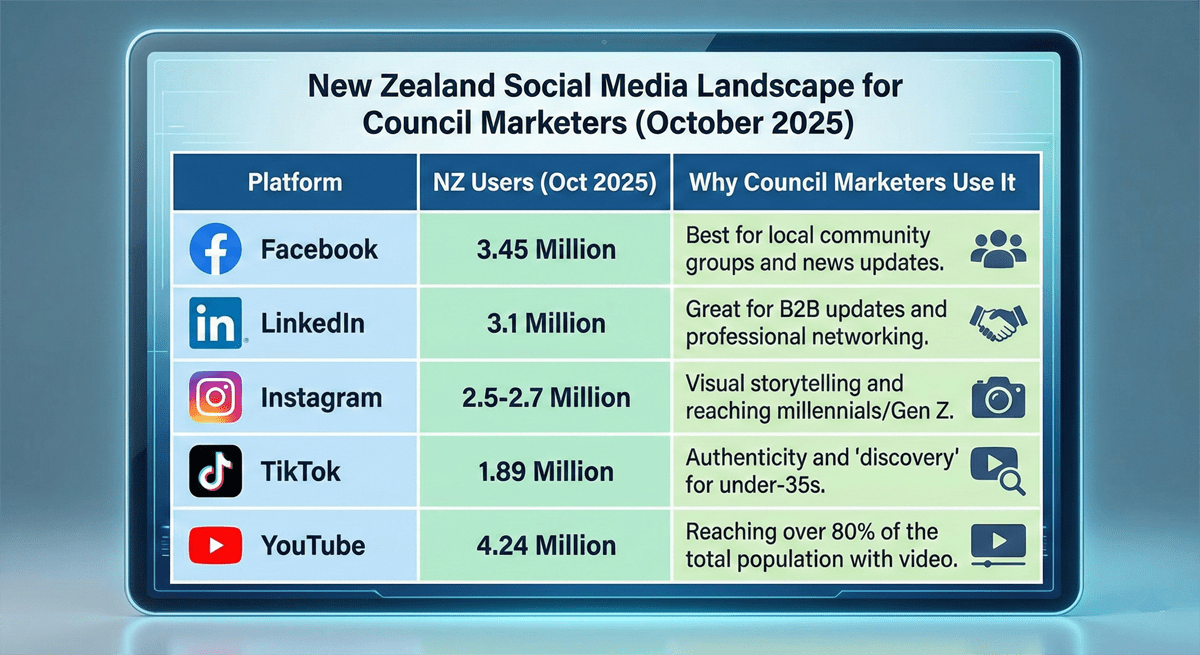
Your social media isn't just a place to post; it's a place to listen. Around 34% of people change their mind about a product or service based on what they read in social reviews. For a council, this means your reputation is being built in the comments section and on local Reddit threads. You need to be there, answering questions and engaging in "real conversations".
The Rise of Social Search
One of the biggest shifts you'll see in 2026 is that TikTok and Instagram are replacing Google as search engines for younger generations. They're looking for local services and community reviews directly on these apps. This means you must optimise your captions and hashtags for search, not just for engagement. If someone searches "best dog parks in Auckland" on TikTok, your council's video should be the one they find.
AI: Your New Creative Engine, Not Your Replacement
You've probably seen the headlines about AI "taking jobs," but in New Zealand local government, the focus is on AI as a "creative engine." It's helping small teams do the work of much larger ones. In fact, 79% of marketers say AI has improved their performance in the last year.
Instead of staring at a blank screen, you can use AI to brainstorm post ideas, draft captions, and even generate visuals. But here's the catch: you can't just copy-paste from ChatGPT. That's how you end up with "AI slop" that residents will ignore.
The Inland Revenue (IR) Model for AI Fluency
If you're wondering how to get your team ready for AI, look at what Inland Revenue did. They launched an "AI fluency" programme in late 2024 to train over 2,000 staff. They didn't just give everyone a login; they tailored the training for different levels:
-
Executive Leadership: Focused on governance and strategy.
-
Business Leaders: Used e-learning modules to understand risks.
-
Working Groups: Took an intensive 4-week course ending in a "Dragon's Den" style pitch for real projects.
This model ensures that AI isn't just an "experiment" but is integrated into "business as usual." For a council, this could mean using AI to summarise public consultation feedback or to create "plain English" versions of complicated planning documents.
Case Study: Waimakariri District Council's Digital Strategy
Waimakariri provides a great example of how a council can future-proof its communications. Their strategy identifies that "post volume doesn't mean post value". They moved away from just "doing PR" and focused on "conversion"—which they measure as residents actually understanding and engaging with a project.
They've focused on:
-
Platform Integration: Using a central platform (Squiz) for all their campaign-based engagement.
-
Audience-Centricity: Shifting from "how the council wants to talk" to "how people want to receive messages".
-
Digital Payment Portals: Moving more transactions online to save residents time and the council money.
This focus on the "Message" and the "Medium" as the two building blocks of success is something every council team can learn from. It’s about being "proactive" rather than "reactive" with your asset management and community engagement.
Measuring Success: Moving Beyond Vanity Metrics
What does success look like in 2026? It's not about how many "likes" your last post got. Those are vanity metrics. Instead, you should be looking at "attention metrics" and "impact metrics".
| Metric | Why It Matters Now |
| Scroll-Stop Rate |
Shows if your content actually caught someone's eye in a busy feed. |
| Save/Share Rate |
Indicates that your information was valuable enough to keep or pass on. |
| Brand Sentiment |
How residents feel about your council in AI-generated summaries. |
| Conversion to Digital |
The number of people who completed a task online instead of calling your office. |
Successful councils use data to guide their decisions. They review their analytics monthly and ask: Which posts drove the most clicks? Which topics generated the most "saves"? Which video format performed best?. By doing more of what works and less of what doesn't, you can make your limited budget go much further.
Managing the "Human Touch" in a Post-AI World
As you roll out more digital tools, you might worry that you're losing the personal connection with your community. In fact, research shows that nearly half of Kiwis want more human-facing support when using government services. The trick is to use AI for the "heavy lifting" so your team has more time for face-to-face engagement.
AI can handle the admin-heavy tasks—like answering basic questions on a chatbot—redirecting your staff to high-impact community services. This is what we call "Cyborg Marketing": using the machine for structure and speed, but ensuring the final voice, opinion, and empathy are unmistakably human.
The Importance of Trust and Ethics
With more AI comes more risk. Residents are smart, and they can detect "performative bs" from a mile away. You need clear guidelines for how you use AI. This includes being transparent about when a bot is answering a query and ensuring that your data infrastructure protects resident privacy.
Inland Revenue's model includes "Trust, Ethics and Governance" as a core training module. Your council should do the same. If residents don't trust your digital tools, they simply won't use them, no matter how "innovative" they are.
FAQs for Council Marketers
Q: How can we rank in AI search results like ChatGPT?
A: Focus on "Answer Engine Optimisation." This means writing clear, factual answers to the common questions residents ask. Use structured data (schema markup) so bots can easily read your site, and try to get your council mentioned in trusted local news and forums.
Q: What is the biggest challenge with AI content in 2026?
A: The biggest fear is "oversaturation" and "AI slop." To avoid this, you should use AI to help with research and drafting, but always ensure a human editor adds local context, "Kiwi flavour," and a personal sign-off to make the content feel authentic.
Q: Do we still need to worry about traditional SEO?
A: Yes! While answer engines are growing, Google is still projected to handle over 5 trillion searches this year. Traditional SEO builds your "topical authority," which is exactly what AI answer engines look for when they're deciding which source to quote.
Q: Is video really necessary for local government?
A: It is if you want to be seen. Online video is now New Zealand's most popular broadcast medium. Short, "lo-fi" videos showing your team at work or explaining a service are far more effective than static images or long text posts.
Q: How do we handle the new accessibility standards?
A: Start by auditing your most-visited pages against WCAG 2.2 Level AA. Focus on simple language, clear headings, and ensuring all buttons work for keyboard users. Moving away from static PDFs to web-native HTML is also a key step for long-term compliance.
Looking Forward: Your 2026 Action Plan
The digital landscape is changing fast, but the goal for your council hasn't changed. It's still about connecting with your people, building trust, and making it easy for them to access what they need.
To stay ahead, you should:
-
Upskill your team: Don't just buy new tools; invest in AI literacy and accessibility training.
-
Audit your foundations: Ensure your website is machine-readable and fully accessible.
-
Be authentic: Embrace lo-fi video and real conversations on social media.
-
Partner with iwi: Ensure your digital transformation is culturally inclusive and addresses the digital divide.
By focusing on these areas, you can ensure your council remains a trusted, helpful, and visible part of your community's daily life—no matter how they choose to search for you.
--
We also offer a training course specifically for Local Government. Details here:
Digital Marketing Essentials for Local Government 2026 course
Our "Digital Marketing Essentials for Local Government 2026" course is designed to equip NZ local government communications teams and marketing professionals with the knowledge and skills required to stay relevant in an ever-changing digital landscape. The course maintains the core digital marketing principles while incorporating council-specific considerations, compliance requirements, and public sector best practices.