Some AI Marketing Mistakes Are Well-Known. Others, Not So Much.
Are you rushing to integrate ChatGPT into every part of your marketing plan? You aren't alone. Across New Zealand, marketers and business owners are jumping on the generative AI bandwagon. Everyone wants to automate their workflow, accelerate content creation, and save time. But rushing headfirst into new technology creates problems. We see the same AI marketing mistakes popping up repeatedly, from Auckland agencies to small businesses in Wellington.
The Obvious AI Marketing Mistakes
Some common mistakes are obvious:
Losing Your Unique Brand Voice
One of the biggest blunders we see is the loss of a distinct brand voice. When you ask AI to generate an email subject line or a blog post without providing a detailed prompt, it defaults to a polite, bland, and overly enthusiastic tone.
Kiwi consumers value authenticity. They want to hear from real people. If your brand normally uses a relaxed, slightly informal tone with local slang, a sudden shift to robotic, corporate-speak will immediately raise red flags. Your readers will spot AI-written text from a mile away.
Implementing AI Without Adequate Human Oversight
Are you letting AI handle your customer interactions completely unchecked? Some marketers set up AI-powered chatbots or automated email sequences and then walk away. This "set and forget" mentality is dangerous.
AI works best as an assistant, not a manager. When you operate without human oversight, you leave your customer experience vulnerable to embarrassing errors. AI can hallucinate facts, misinterpret customer complaints, and offer entirely wrong solutions.
Not Taking Account of Marketing Data and Strategic Direction
Another common error is jumping into AI content creation without a solid marketing strategy. Using AI to generate hundreds of blog posts or LinkedIn updates won't help your business if those posts don't target the right keywords or address your customers' actual pain points.
Many marketing teams get distracted by the novelty of generative AI. They focus on how quickly they can produce ad copy or social media graphics, rather than why they are creating them. This is a classic case of valuing output volume over strategic direction.
AI tools offer incredible speed, but speed is useless if you are running in the wrong direction. You need to base your marketing efforts on solid marketing data.
Misunderstanding How AI Works with SEO
Search engine optimisation (SEO) has changed dramatically since the arrival of AI. A massive mistake marketers make is using AI to churn out high volumes of low-quality articles, hoping to trick Google into giving them better rankings.
Google's algorithms are smart enough to recognize generic, unhelpful content. If you publish articles that simply repeat what’s already ranking on the first page, without adding any new insights, you will not see a boost in traffic.
AI can write a 1000-word article in seconds. But if that article lacks originality, real-world examples, or a strong point of view, it won't rank. It is just more digital noise.
The Less Obvious, More Surprising AI Marketing Mistakes
Here are 15 AI marketing mistakes that don't get nearly enough airtime:
1: Training AI on your worst content
When you feed AI your existing content to "learn your brand," it learns everything — including the mediocre stuff. That average blog post from 2021, the rushed email campaign, the off-brand social post someone published on a Friday afternoon. AI will average it all out. If you're using your own content as training material or context, curate it deliberately. Only feed it the work you're actually proud of.
2: Using AI to make decisions it doesn’t have enough information to make
AI-powered analytics tools are brilliant at surfacing patterns — "posts published on Tuesday get 34% more engagement." So marketers take that and run with it, posting everything on Tuesdays. But AI can tell you what happened, not why. Acting on AI-generated insights without human interpretation leads to optimising for correlation instead of cause. The pattern might be a coincidence, an anomaly, or only true for a specific audience segment. Always ask "why might this be true?" before changing strategy.
3: Letting AI homogenise your point of view
Because AI tools are trained on the same vast pools of internet content, they naturally gravitate toward the middle — the most common takes, the safest framing, the average opinion. If you use AI to generate your thought leadership content, you risk sounding exactly like everyone else in your industry. Over time, your brand loses the distinctiveness that actually makes people choose you. The contrarian angle, the unpopular opinion, the genuinely fresh perspective — those still have to come from a human with something real to say.
4: Applying AI to a broken process and calling it transformation
AI is very good at making things faster. The problem is that "faster" applied to a broken workflow just produces bad results more quickly. If your lead nurturing emails weren't converting before, automating them with AI won't fix that — it'll just send the wrong message to more people, faster. Before you bring AI into any process, check whether the process itself is actually working. Fix the fundamentals first, then use AI to scale what's already good.
5: Over-personalising until it feels creepy
AI makes hyper-personalisation easy — using someone's name, their location, their browsing behaviour, their past purchases, all in one email. But there's a well-documented point where personalisation crosses from "this feels relevant" to "this feels like they're watching me." For Kiwi audiences especially, that kind of surveillance-flavoured marketing tends to backfire. More data points in your personalisation engine doesn't automatically mean a better customer experience. Know where the line is for your audience.
6: Creating Messy "AI Silos" with Disconnected Tools
Many Kiwi businesses jump on every new trend. They buy one tool for writing emails, another for editing videos, and a third for scheduling social posts.
The result? A tangled mess of disconnected software.
When your tools don’t talk to each other, your marketing data gets trapped in silos. An integrated system sees your full marketing picture. A bunch of random apps just creates extra administrative work for your team. You end up spending more time managing the software than you do marketing to your target audiences.
How to Fix It
Consolidate your tech stack. Look for platforms that integrate smoothly with your existing CRM and marketing systems. When your data flows freely between tools, you get a much clearer picture of your customer journey.
7: Falling into the Copyright and IP Trap
It ‘s easy to let a generative platform draft your latest eBook or product descriptions. But did you know you might not own that content?
Content created entirely by machines often lacks copyright protection. If your competitors copy your AI-generated sales copy word-for-word, you might have zero legal recourse to stop them. Plus, these models scrape the internet for training data. Your shiny new campaign might accidentally plagiarise someone else's protected work.
Why Ownership Matters
Building a brand means building intellectual property. If you rely completely on machines to write your core assets, you weaken your company's value.
To fix this, treat the technology as a brainstorming partner. Let it generate ideas or outlines, but make sure a human writer crafts the final product. Document your editing process to prove human authorship.
8: Measuring Vanity Output Over Actual ROI
Do you measure success by how many blog posts you published this week? If so, you are tracking the wrong numbers.
Volume does not equal value. Producing 50 generic articles a month means nothing if your customer acquisition cost stays exactly the same. We see teams bragging about the time they saved, while completely ignoring whether those automated campaigns actually drove revenue.
Focus on Hard Metrics
Stop tracking output and start tracking business impact.
- Look at your conversion rates.
- Monitor your cost per lead.
- Track the actual pipeline generated from your campaigns.
If the technology is not improving these hard metrics, you need to adjust your approach.
9: Letting Algorithms Optimise for the Wrong Goals
Algorithms are incredibly obedient. If you tell an automated ad platform to get you the cheapest clicks possible, it will do exactly that.
The problem? Cheap clicks rarely convert into paying customers. When you let a model optimise your media spend without giving it the right business context, it moves in the wrong direction. It chases short-term efficiency while destroying your long-term brand equity.
Giving Context to the Machine
You must give clear parameters to your automated systems. Do not let them run blind. Feed them high-quality, first-party data. Set strict limits on ad frequency to avoid annoying your audience. Always review the data behind the model to confirm it aligns with your broader business goals.
10: Deploying Chatbots Without Safety Guardrails
You’ve probably seen some of the horror stories. A frustrated customer asks a simple question, and the company's automated chatbot replies with a robotic, unhelpful loop. Or worse, the bot starts offering incorrect advice or giving away fake discounts.
Using bots for customer service is great for speed, but terrible for empathy. When you deploy a chatbot without strict escalation rules, you risk severe reputational damage. A machine cannot handle nuanced complaints or sensitive issues.
Building a Safe Escalation Path
Never leave your customers trapped in an automated loop.
- Program clear triggers that immediately pass the conversation to a human agent.
- Test your chatbots regularly with unusual questions.
- Monitor the conversation logs daily.
Your customers expect quick answers, but they also demand respect. Always offer a fast, easy way to speak to a real person.
11: Letting AI Do Your Competitive Analysis Without Local Kiwi Context
You feed a competitor’s website into an AI tool and get a beautiful report on their strategy. Looks smart. But the AI has no clue that their “aggressive pricing” works in Australia yet fails in New Zealand because Kiwi buyers still trust “made local” more than rock-bottom prices.
Result? You copy tactics that make zero sense here and end up blending into the crowd instead of standing out.
How to fix it
- Use AI only for raw data collection
- Have a human (you or your team) add the Kiwi layer: “How does this play in a country with high trust in local brands and sensitivity to overseas influence?”
- Run one monthly “human context” review session – 30 minutes max
12: Building Campaigns Around What AI Can Do Instead of What Your Customers Actually Need
This one is sneaky. You discover a flashy new generative AI feature (hyper-personalised video ads, AI voiceovers, dynamic product bundles) and suddenly your whole quarter revolves around using it. The campaign looks cutting-edge on paper but solves problems your Auckland or Dunedin customers never had.
Small businesses especially fall into this trap because the tools are so tempting and the demos look amazing.
How to fix it
- Start every campaign brief with customer research, not tool capabilities
- Ask: “Would we run this campaign if this AI feature didn’t exist?”
- If the answer is no, scrap it or redesign it around real customer pain
13: Assuming Your Team Will “Just Figure Out” How to Work With AI
You roll out ChatGPT, Midjourney, or Claude to the marketing team and expect magic. Six weeks later half the team is under-using it, the other half is wasting hours on bad prompts, and no one is sharing what actually works.
In tight Kiwi teams where everyone already wears three hats, this silent skill gap becomes a massive drag on productivity.
How to fix it
- Run one 45-minute “AI lunch and learn” every fortnight – real examples only, no theory
- Create a shared Notion/Google Doc of winning prompts specific to your brand
- Make it safe for anyone to say “I still don’t get this” – the fastest learners admit what they don’t know
- Check out our AI Marketing courses (details below)
14: Using AI to Generate Visuals Without Checking New Zealand Cultural Fit
AI image tools spit out beautiful pictures in seconds. But they regularly miss bicultural nuances, Treaty principles, correct Māori imagery, or even simple things like realistic Kiwi street scenes (wrong power poles, wrong cars, wrong body language). One wrong visual and your campaign can go from professional to tone-deaf overnight.
How to fix it
- Always generate 3–4 options, then run them past someone with strong cultural knowledge
- Add specific prompts: “photorealistic Auckland CBD footpath, diverse Kiwi crowd including Māori and Pasifika, natural lighting, no American-style elements”
- Keep a “never use” list of common AI fails for your industry
15: Ignoring the Hidden Long-Term Cost of AI Skill Atrophy
This is the quietest killer of all. The more you let AI write your first drafts, analyse your data, and brainstorm ideas, the less your marketing team practises those core skills. Six months later you have faster output but weaker strategic thinking. When the AI tools change, raise prices, or go down, you’re suddenly exposed.
NZ small businesses feel this hardest because you can’t just hire a big specialist team to fill the gap.
How to fix it
- Once a month run a “no-AI day” – plan, write, and analyse everything manually
- Track not just output speed but strategic quality (e.g. originality of ideas, depth of customer insight)
- Celebrate human wins publicly: “This campaign idea came 100% from the team – no AI involved”
People Also Ask: AI Marketing FAQs
Q: Can AI replace my marketing team? No. AI is a tool, not a replacement for human creativity and strategic thinking. While AI can handle repetitive tasks and help brainstorm ideas, you still need human direction to craft compelling stories, understand local Kiwi nuances, and build relationships with your customers.
Q: How do you use AI for email marketing? You should use AI to help segment your audience, test different email subject lines, and draft initial copy. You must always reviewand edit the generated content to ensure it matches your brand's tone and addresses the specific needs of your subscribers. Avoid blasting generic, automated emails to your entire list.
Q: Is AI-generated content bad for SEO? AI-generated content is only bad for SEO if it is generic, unhelpful, and lacks original insight. Search engines reward content that provides value to the reader. If you use AI to simply rephrase existing articles without adding any new information, you will struggle to rank. Use AI to assist with research and outlining, but rely on human writers to produce the final, high-quality piece.
Q: How can NZ Marketers implement AI safely? Start with small AI pilots. Pick one task to automate, test the results, and train your staff on how to write effective prompts. Always maintain human oversight and never let an AI tool interact directly with your customers without a thorough review process in place.
How Marketers in New Zealand Can Use AI Safely and Effectively
Marketers often feel they must adopt AI or fall behind. The good news? You can start small and stay in control.
Focus on tasks that benefit most from AI: first drafts, data analysis, and repetitive jobs. Keep strategy, creative direction, and customer relationships firmly in human hands.
Many successful NZ brands now combine AI tools with clear human oversight. They automate the boring stuff and spend more time on the work that actually grows their business.
Turning AI Marketing Mistakes Into Wins
Every mistake above has a straightforward fix. The key is treating AI as a helpful teammate, not the boss.
Start by reviewing one campaign you ran with AI in the last month. Spot which mistakes appeared. Apply the fixes and measure the improvement. You will see better engagement, stronger brand trust, and campaigns that actually resonate with Kiwi audiences.
Learning More About Using AI for Marketing
We've been offering AI courses since ChatGPT first came along in late 2022.
All our courses now include AI content, but we have several courses that are specifically designed to help you master AI.
Here are our current courses (click on the links for more details about each course):
--
MARKETING WITH AI - INTRODUCTORY
It’s now more important than ever for businesses to master the essential elements of AI for marketing.
Dive into the digital future with our Marketing with AI introductory course! This exclusive training is your golden ticket to mastering AI in the marketing realm, specially designed for New Zealand’s vibrant marketing community.
Unlock the power to revolutionize your strategies, elevate content creation, and decode consumer insights like never before. Whether you’re aiming to amplify engagement, boost conversions, or innovate with unparalleled personalization, this course is your pathway to becoming an AI-savvy marketer.
Check out the details of our Marketing with AI introductory online training course here.
--
THE PRODUCTIVE AI MARKETER
So you're happy that you’ve mastered ChatGPT and have been using AI for content creation for some time? Now you’d like to expand your use of AI to really accelerate your marketing effectiveness and productivity.
Check out the details of our Productive AI Marketer online training course here.
ADVANCED AI FOR MARKETERS
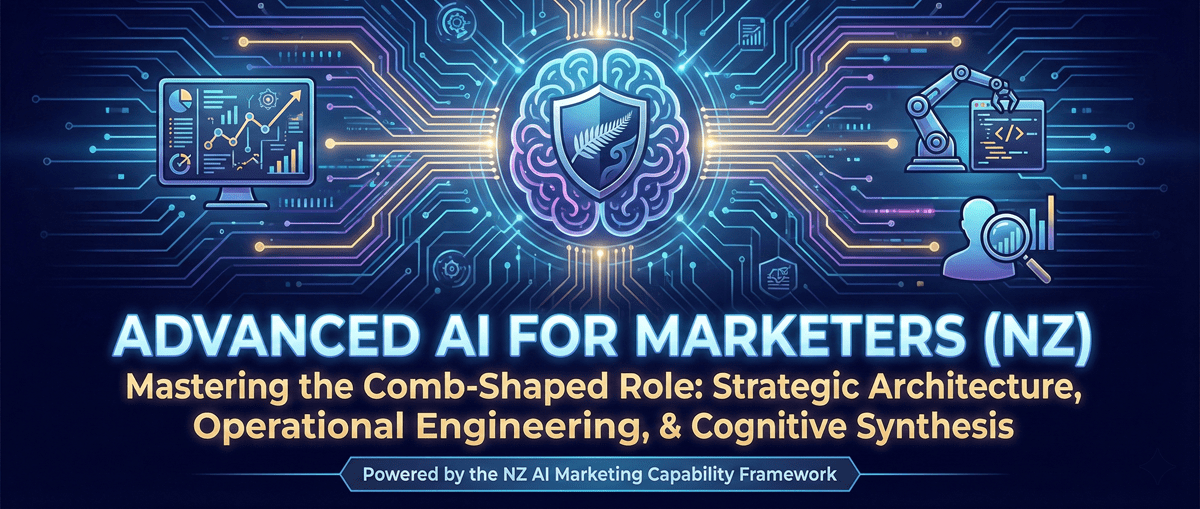
The Advanced AI for Marketers course is an eleven-week, browser-based program designed for experienced New Zealand marketing professionals, digital leads, and brand managers who want to transition from casual AI users to strategic "orchestrators" of autonomous systems.
By the end of the course, students are expected to possess the technical and strategic skills to build multi-agent workflows and lead AI transformation within their organizations.
Check out the details of our Advanced AI for Marketers online training course here.
--
AI MARKETING FOR NZ SMALL BUSINESS
For Kiwi small business owners and solo operators, AI offers a massive opportunity to compete with larger rivals by saving time and cutting costs. This nine-lesson course cuts through the technical jargon to show you exactly how to use AI tools for practical tasks—like drafting social media posts, responding to customer queries 24/7 with chatbots, and analysing your sales data. We also cover the essential "Kiwi" context, ensuring you know how to use these tools safely and legally within New Zealand's privacy regulations.
Read the full details of the AI Marketing for NZ Small Business course here.
--
Vital AI Marketing Skills for 2026
- Master AI as Your Strategic Advantage
- Become the Strategic Generalist Your Team Needs
- Prove Your Marketing Impact with Confidence
- Lead Through Influence, Regardless of Your Title
What makes this course different? Every single lesson includes hands-on AI-powered exercises designed to accelerate your learning and mirror how you'll actually work in 2026.
Read all about the Vital AI Marketing Skills 2026 course by clicking here.
AI FOR ADVERTISING PROFESSIONALS
Designed for advertising professionals across the board—whether you're agency-side, in-house, or freelancing—this ten-part course cuts through the hype to deliver practical, hands-on training. We demystify the technology and show you exactly how to apply AI to your daily workflow, from prompt engineering and content creation to design, video, and media buying.
Check out the details of our AI for Advertising Professionals course here.
--
AI-ENHANCED NZ RETAIL MARKETING MASTERCLASS
Specifically tailored for the New Zealand retail environment, this 12-lesson masterclass helps you work smarter, not harder. You'll learn to use AI as your strategic co-pilot to automate repetitive tasks and generate fresh marketing ideas. Each lesson comes with a unique, customised AI tool to help you streamline everything from customer profiling and strategy to content creation and email marketing.
Read all about the AI-Enhanced NZ Retail Marketing Masterclass by clicking here.
--
NZ TOURISM MARKETING – AI-ENHANCED MASTERCLASS
In 2026, AI is essential for staying competitive in tourism. This masterclass is designed to help Kiwi tourism operators free themselves from time-consuming administrative tasks and focus on what matters most: delighting guests. Over 12 comprehensive lessons, you'll gain access to custom AI tools that assist with storytelling, responding to reviews, planning strategy, and creating "scroll-stopping" social content.