
The Necessary Advertising & Marketing Skills for NZ 2026
I gave a guest lecture at the University of Auckland in September last year, to their Advertising & Marketing course, and the keenest questions at the end boiled down to: what do I need, to get a job in the advertising and marketing industry?
As I told them then, and reiterate now, you need to master the use of AI.
Our own research into NZ Marketing Job Ads, conducted in July 2025, showed that AI is now the most sought-after skill for advertising and marketing jobs:
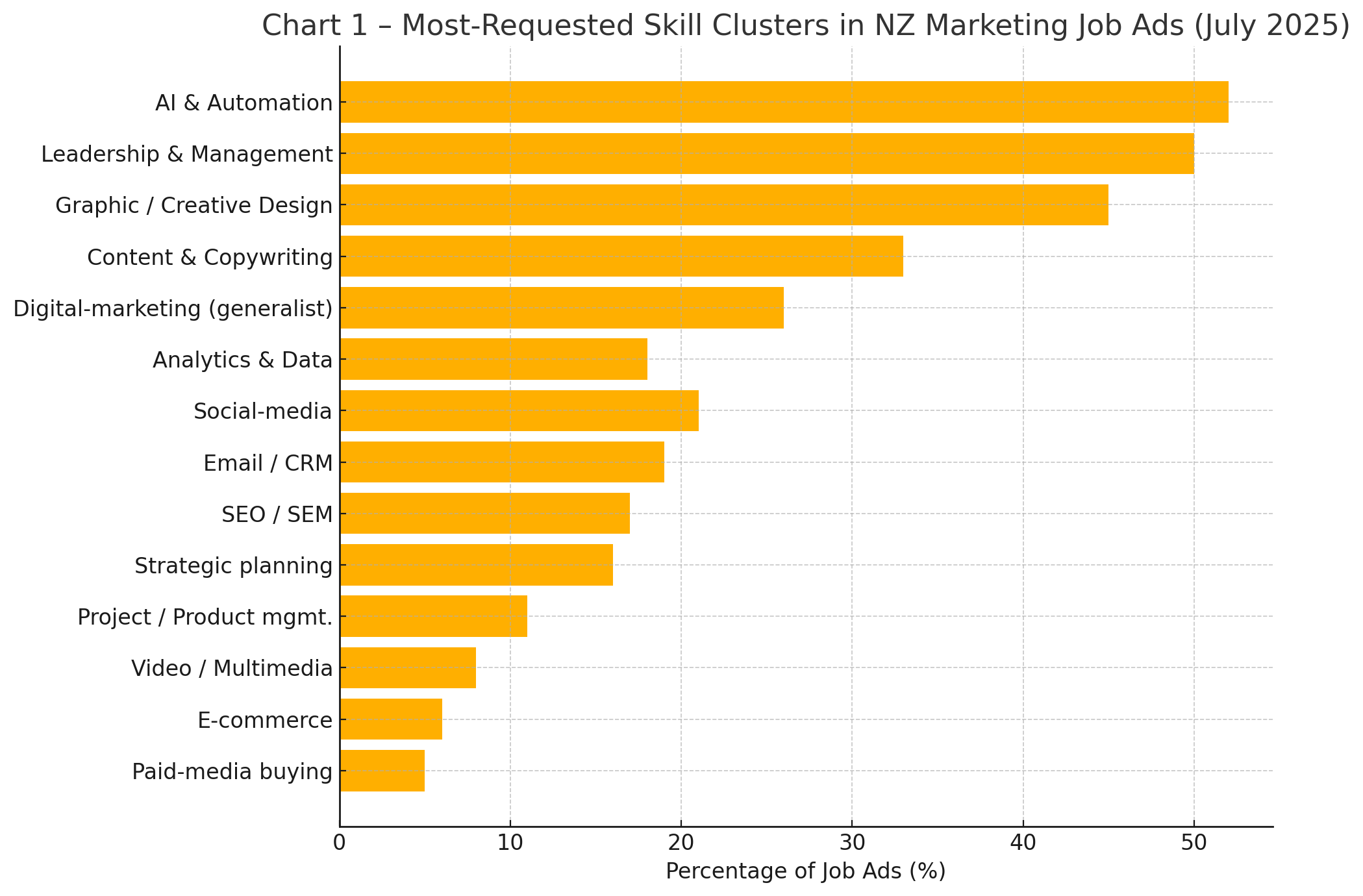
Other data confirms the trend:
- According to IDNZ, 75.8% of marketers see AI expertise as a major skills gap, but only 5% feel fully proficient
- The NZ Digital Marketing Institute reports that 75% of companies who use AI are moving teams toward high-level activities like planning and innovation
- Evidence leans toward AI boosting personalization and efficiency, though some debate its impact on creative jobs—balance is key for sustainable growth.
- Kiwi businesses adopting AI early report better engagement with local trends, from urban tech-savvy audiences to rural community-focused campaigns.
Why Employers Are Desperate for AI-Savvy Marketers
Browse Seek or Trade Me Jobs right now, and you'll see "AI experience" or "familiarity with AI tools" popping up in requirements for everything from content managers to marketing directors.
Here's why: businesses have invested in AI tools, but many are struggling to use them effectively. They need marketers who can bridge the gap between the technology and actual business results. Someone who knows how to prompt an AI writing tool properly. Someone who can interpret AI-generated insights and turn them into strategy. Someone who understands both marketing principles and how to work alongside AI systems.
This skills gap has created serious demand. Marketers with proven AI experience can command higher salaries and have their pick of roles. More importantly, they're producing measurably better results than those still doing everything manually.
"Your job will not be taken by AI… it will be taken by a person who knows how to use AI".
It's a cliche for a reason: it reflects today's reality.
Industry data backs this up—HubSpot’s co-founder says marketers who master AI gain a clear career advantage. Surveys show nearly all brands now use AI in marketing, and NZ leaders expect AI to reshape campaigns and roles. Here’s why AI is the most sought-after skill for NZ marketers, how it’s transforming advertising, and how you can upskill to stay ahead.
Marketing is changing fast, and NZ is no exception. Leading companies now prioritise AI skills. HubSpot’s co-founder notes that AI skills are essential for career growth. Globally, analysts say we’re at a tipping point—marketers who use AI strategically will gain a clear advantage. A recent survey found almost 94% of brands are already using AI in some way; tasks like writing ad copy (77%), personalising emails (43%), and audience targeting (32%) are all powered by AI. Most marketing teams (83%) say their top goal with AI is saving time on routine work. Crucially, over half of marketers view AI as a tool that enhances their role, not replaces it. Kiwi leaders feel this too: one NZ survey found 81% of business owners expect AI to impact operations, and about 40% say they’ll need dedicated AI specialists.
Why does this matter to you? Because upskilling in AI can set you apart. A New Zealand marketing study bluntly states that “AI is no longer optional. Most brands are already using it”. In other words, marketers who learn AI can run smarter campaigns and drive better results, while those who don’t risk falling behind the competition.
How AI is Changing Advertising and Marketing
AI is reshaping almost every marketing function. Key areas where Kiwi advertisers and marketers feel the impact include:
- Content Creation (Copywriting, Design, Videos): Tools like ChatGPT and Canva AI can draft blog posts, social ads, and emails in seconds. Brands use AI to generate first drafts and then polish them. This speeds up workflows: one NZ expert notes that AI tools can save marketers 5–10 hours per week on routine tasks.
- Smart Advertising Campaigns: AI-powered platforms (e.g. Google Ads, Facebook) handle bidding and placement automatically. Generative AI can even create ad visuals. Local experts highlight AI chatbots and automated follow-ups that handle leads 24/7. New Zealand businesses can launch ads that adapt in real time to each user, increasing engagement.
- Personalisation: Kiwi customers expect customised experiences. AI analyses data to tailor messages—recommending products or timing emails perfectly. In fact, surveys show 43% of marketers use AI for personalising email content and 32% for targeting ads. This means every customer can get a message tuned to their interests, boosting results.
- Data Analytics and Insights: AI-powered analytics tools sift through mountains of data faster than any person. They spot trends and predict customer behaviours, freeing you to focus on strategy. HubSpot experts note that with AI handling “the heavy lifting” of data management, marketers can spend more time on creative planning. AI-driven tools can automatically highlight which campaigns work best.
- Chatbots and Customer Engagement: AI chatbots on websites and social media answer customer queries instantly, 24/7. They qualify leads, suggest products, and book appointments without human intervention. In NZ’s service-driven market, this means your team never misses an inquiry after hours. In practice, a chatbot can save your salespeople from routine follow-ups so they focus on high-value prospects.
These examples show why marketers need to master AI. It’s not just about automation; it’s about working smarter. New Zealand analysts warn that without proper training, teams can misuse AI and see poor results. By contrast, knowledgeable marketers can let AI handle routine work and spend more time on strategy and storytelling—the human strengths AI can’t copy.
Key AI Skills and Tools for Marketers
AI for marketing isn’t a single skill but a toolkit of capabilities. Important skills include:
- AI Fundamentals: Know basic concepts like machine learning, natural language processing (NLP) and generative AI. You don’t need a tech degree, but understand what tools like chatbots and predictive algorithms do.
- Data Literacy: AI relies on data. Be comfortable with spreadsheets and analytics. Learn to pull insights from tools like Google Analytics or your CRM (customer relationship management) system. NZ courses often teach how to automate data analysis so your decisions are evidence-based.
- Prompt Writing: The way you “prompt” an AI (give it a task) makes a big difference. Practice asking clear, specific questions to tools like ChatGPT or Claude. Good prompts yield better outputs. Training programs (like the NZIE AI course) teach how to craft prompts and evaluate AI results.
- Creative and Strategic Judgment: AI can draft content or suggest ideas, but you supply the creativity. Hone your marketing instincts to refine AI outputs. For example, if AI generates ad copy, apply your brand’s voice and Kiwi cultural touches to make it resonate. Human judgment is still essential.
- Tool Proficiency: Get hands-on with AI tools. Start with user-friendly options: try ChatGPT for writing and Canva AI for images. Then explore platforms like AI-driven CRMs or analytics software. The more you experiment, the faster your skills grow.
- Ethical Use: AI has pitfalls. Always fact-check AI-generated content because it can “hallucinate” errors. Respect privacy by using customer data responsibly. NZ experts note that lack of training often leads to mistakes. Being aware of AI’s limits will make you a more credible marketer.
- AI-Enhanced Marketing Planning: Finally, integrate AI into your strategies. This might mean using AI tools for A/B testing, lead scoring, or forecasting. Marketers who treat AI as part of their marketing strategy—rather than an add-on—will see the best results.

The "Human in the Loop": Why You Are Still Essential
AI is terrible at empathy. It doesn't understand cultural nuance, specifically the Kiwi context. It doesn't know what it feels like to be a customer. It lacks creativity and strategic intuition.
Your job is to be the editor, the strategist, and the guardian of the brand. You provide the strategic thinking; the AI provides the raw material. The most successful AI strategies are those where the human element is front and centre, guiding the technology to serve real people.
Potential Drawbacks of AI and How to Overcome Them
No tech is perfect, and AI in marketing has its challenges. One big issue is over-reliance on AI tools, which might stifle creativity and strategic thinking. There's also the risk of data privacy concerns, especially under New Zealand's strict regulations.
To tackle this, focus on best practices like always reviewing AI outputs for accuracy. Use AI as an assistant, not a replacement—pair it with your human insight for marketing use cases. Training programs can help; start with hands-on sessions to build confidence in using AI effectively.
How NZ Marketers Can Upskill in AI
Ready to start learning? Here are practical steps for Kiwi marketers:
1 Online Course
Enrol in AI marketing classes. We offer a number of courses that focus on the use of AI for advertising and marketing:
Check out the details of our AI for Marketers online training course here.
Also see the details of our Advanced AI for Marketers online training course here.
We also offer specialist courses designed to help you use AI effectively for Retail Marketing, Tourism Marketing and Small Business Marketing.
2 Workshops and Webinars
Attend marketing events and webinars. The NZ Marketing Association and industry conferences often feature talks on AI trends. Even free online seminars can give you practical tips and tool demos from experts.
3 Hands-On Practice
Learning by doing is crucial. Try AI tools on real projects. Ask ChatGPT to draft a campaign email or use an AI tool to generate social media graphics. New Zealanders often start by experimenting on their own – curiosity is a great teacher. After each experiment, review the results and tweak your approach.
4 Peer Learning
Form a study group at work or join online communities (e.g. marketing forums or LinkedIn groups). Share tips with colleagues and learn from fellow NZ marketers’ experiences. Cross-training with colleagues who are more tech-savvy can accelerate your learning.
5 Integrate AI on the Job
Apply AI gradually in your daily work. For example, automate one routine task each month (like scheduling posts with an AI social tool). Track your wins (time saved, improved metrics) to build momentum. Small steps will make AI a natural part of your workflow.
Learning AI is an ongoing process. The key advice from NZ experts is to focus on people and training – the rest will follow. By investing in your own skills and sharing knowledge at work, you’ll lead the AI transition.
How to Use AI in Your Marketing Strategies
Ready to incorporate AI into your marketing strategies? Start by identifying areas like content creation or SEO where AI can add value.
For example, use ChatGPT for brainstorming marketing campaign ideas, then refine them with your team's input. AI-powered analytics can optimise workflows, spotting trends in customer data. In Kiwi contexts, this might mean analysing local search data to boost visibility for NZ-specific terms.
Common Mistakes When Learning AI for Marketing
Watching marketers dive into AI, we've noticed some patterns of mistakes that slow down progress. Avoid these and you'll learn faster.
Trying to Learn Everything at Once
The AI marketing space is massive. Trying to master every tool and technique simultaneously is a recipe for overwhelm. Pick one area—maybe content creation or ad optimisation—and get good at that first. Then expand.
Trusting AI Outputs Blindly
AI makes mistakes. It hallucinates facts, misunderstands context, and sometimes generates content that sounds good but is factually wrong or strategically misguided. Always verify AI-generated information, especially statistics and claims. Add your own knowledge and judgement to AI outputs.
Ignoring the Human Element
AI is a tool, not a replacement for marketing expertise. The marketers struggling with AI are those trying to use it as a substitute for strategy and creativity. Use AI to enhance your work, not to avoid doing the thinking.
Expecting Instant Mastery
Like any skill, getting good with AI takes time and practice. Your first attempts at prompt engineering will probably produce mediocre results. Your initial experiments with AI analytics might not yield groundbreaking insights. That's normal. Keep practising.
Forgetting About Your Audience
AI doesn't understand your specific Kiwi audience the way you do. It doesn't know the cultural nuances, local references, or specific pain points of New Zealand customers. You need to bring that knowledge to AI interactions, guiding it to produce content and strategies that actually resonate locally.
The Business Case for AI Upskilling
If you're trying to convince your boss to support your AI upskilling—or convince yourself it's worth the time investment—here are the numbers that matter.
Marketers using AI tools report saving an average of 12 hours per week on repetitive tasks. That's time redirected to strategy, creativity, and higher-value work. Campaigns optimised with AI assistance show average performance improvements of 20-30% across key metrics like engagement and conversion rates.
For businesses, having AI-skilled marketers means:
- Faster campaign deployment and iteration
- Better targeting and personalisation at scale
- More efficient budget allocation
- Improved ROI on marketing spend
- Competitive advantage over slower-moving competitors
For individual marketers, AI skills mean:
- Higher earning potential (AI-skilled marketers command 15-25% salary premiums)
- Better job security and more employment options
- Ability to produce higher-quality work more efficiently
- Reduced time on tedious tasks, more time on interesting work
The investment in upskilling pays for itself quickly, whether you're measuring in business results or career advancement.
What AI Won't Replace in Marketing
Let's be clear about something: AI won't replace good marketers. It will replace marketers who refuse to adapt, but that's different.
Here's what AI genuinely can't do—and probably won't be able to do for a long time:
Understand Your Specific Business Context
AI doesn't know your company's history, internal politics, brand positioning challenges, or strategic priorities. You do. AI can inform decisions, but it can't make strategic choices that account for all the messy, human complexity of running a business.
Build Real Relationships
Marketing is still about people connecting with people. AI can't build genuine relationships with clients, collaborate with creative teams, or navigate stakeholder management. Those human skills remain irreplaceable.
Apply Judgement and Nuance
AI operates on patterns and probabilities. It can't apply the kind of nuanced judgement that comes from years of marketing experience. It can't tell when breaking the rules makes sense, when to trust your gut over the data, or when a technically optimal solution is strategically wrong.
Create Truly Original Ideas
AI recombines existing patterns in novel ways, but it doesn't create genuinely original thinking. Breakthrough creative ideas, innovative campaign concepts, and brand positioning strategies still require human creativity and intuition.
Navigate Ethics and Values
Deciding what's right, appropriate, or aligned with brand values requires human judgement. AI can flag potential issues, but you make the ethical calls about how to market responsibly.
How AI Marketing Skills Fit with Traditional Marketing Knowledge
Some marketers worry that focusing on AI skills means abandoning traditional marketing knowledge. Actually, the opposite is true. AI skills are most valuable when combined with solid marketing fundamentals.
Understanding audience psychology makes you better at crafting AI prompts that generate persuasive content. Knowing copywriting principles helps you edit and improve AI-generated copy. Grasping strategic planning enables you to use AI insights effectively rather than just following them blindly.
The best AI-augmented marketers aren't tech specialists who learned marketing. They're experienced marketers who learned to work with AI tools. Your existing marketing knowledge isn't obsolete—it's the foundation that makes AI skills valuable.
Think of AI as an amplifier. If you're a mediocre marketer, AI will help you produce mediocre work more quickly. If you're a strong marketer with deep knowledge of strategy, customer psychology, and creative principles, AI will help you produce excellent work at scale.
Step-by-Step Guide to Getting Started with AI for Marketing
- Assess Your Current Skills: Check your AI proficiency—do you understand basic terms?
- Choose the Right Tools: Opt for user-friendly options like HubSpot Academy's AI features or free AI tools for beginners.
- Learn Prompt Engineering: Master creating effective AI prompts to get the best outputs.
- Apply to Real Tasks: Test on small projects, like automating email campaigns.
- Measure and Iterate: Track results and adjust, ensuring AI helps deliver better marketing outcomes.
Balancing AI Efficiency with Authentic Marketing
One concern about AI in marketing is whether it leads to generic, soulless content that all sounds the same. This is a real risk—but only if you use AI poorly.
The marketers producing the best work use AI for efficiency while maintaining authenticity. They use AI to handle research, generate first drafts, and analyse data, then apply their own expertise, brand knowledge, and creativity to create something genuinely valuable.
Here's the balance:
Let AI handle the mechanical aspects: data processing, research aggregation, formatting, initial drafts, routine optimisation. Do the human work yourself: strategy development, brand voice application, creative direction, relationship building, ethical decisions.
Think of AI as a junior team member who's incredibly fast and tireless but needs your direction and editing. You wouldn't let a junior marketer publish content without review. Same with AI.
The best AI-augmented marketing feels human because humans are still driving strategy and adding the touches that create genuine connection. AI amplifies their capability; it doesn't replace their judgement.

Measuring the ROI of Your AI Upskilling
How do you know if your time investment in learning AI skills is paying off? Track these metrics.
Time Savings
Measure how long tasks took before and after implementing AI tools. If you're saving 10 hours a week on content creation, that's quantifiable value.
Performance Improvements
Compare campaign results before and after using AI optimisation. Higher engagement rates, better conversion rates, improved ROI—these numbers prove value.
Career Advancement
Track opportunities that come your way. Are you getting approached for better roles? Commanding higher rates if you're freelance? Taking on more strategic responsibilities?
Quality of Output
Are you producing better work? Getting better feedback from stakeholders? Seeing improved results from your marketing efforts? Quality improvements, even if harder to quantify, matter.
Confidence and Capability
Can you tackle projects you couldn't handle before? Are you more efficient at your current responsibilities? Increased capability, even without immediate external recognition, has value.
Review these metrics quarterly. The ROI of AI upskilling should become clear within 3-6 months if you're applying what you learn consistently.
Conclusion
AI for Marketing is transforming advertising and marketing in New Zealand. Having AI skills is becoming essential for any marketer who wants to stay competitive.
The first step is action: pick an AI tool and try it on a real task, enroll in a course, or experiment with AI-driven analytics. The marketers who embrace AI early will lead the pack; those who wait risk falling behind. Stay curious, keep learning, and use AI to make your marketing smarter and more effective.
FAQ
Q: Will AI replace human marketers?
Not really. Surveys find most marketers believe AI will augment their roles, not replace them. AI handles routine tasks and data crunching, freeing you to focus on strategy and creative work. In fact, only about 5% of businesses say they plan to cut marketing jobs because of AI. As Harvard’s Christina Inge says, “your job will not be taken by AI… it will be taken by a person who knows how to use AI”. By upskilling, you ensure you’re the person in control of the AI, not the other way around.
Q: What are some practical examples of AI in advertising?
Many everyday marketing tasks now use AI. For example, AI powers Google and Facebook ads that automatically adjust to audience behaviour. Over 77% of brands report using AI to write advertising copy. Locally, agencies deploy AI chatbots to qualify leads 24/7. Personalisation is AI-driven too: it can recommend products or content to each customer. Even simple things like email subject line tests are often done by AI algorithms now. In short, AI is already behind many tools you use every day.
Q: What if I’m not very technical? Can I still learn AI marketing?
Absolutely. Most AI marketing tools are user-friendly and require no programming. You’ll find NZ courses do not assume a tech background. Think of AI as another marketing tool—focus on what it can do for campaigns, not how it works under the hood. Start simple: use an AI-powered email scheduler or a drag-and-drop chatbot builder. As you gain experience, you’ll naturally pick up more. Even non-technical marketers can become AI-literate and reap the benefits in their work.
Q: How long does it take to become proficient with AI marketing tools?
Basic proficiency with common AI marketing tools typically takes 2-3 months of regular use. You can start seeing benefits within weeks, but developing strong skills that make you genuinely competitive in the job market usually requires 6-12 months of consistent practice and application. The timeline depends on how much time you dedicate and how actively you apply AI to real projects versus just learning theoretically.
Q: How can small Kiwi businesses afford AI tools?
Many AI-powered tools are surprisingly affordable or have robust free versions. You don't need enterprise-level software to see benefits. Simple tools for copywriting, design, and social media scheduling can save hours of work, providing a high return on investment for small teams.
Q: Which AI tools should NZ marketers prioritise learning first?
Start with the tools that address your biggest challenges. For most marketers, that means beginning with AI writing assistants like ChatGPT or Claude for content tasks, then moving to AI features within platforms you already use—like AI optimisation in Google Ads or Meta's advertising platform. Once comfortable with those, explore specialised tools for your specific needs like email automation, social media management, or analytics platforms.
Q: Which courses should I take?
We offer a number of courses that focus on the use of AI for advertising and marketing. Follow the links for more details.
Check out the details of our AI for Marketers online training course here.
Also see the details of our Advanced AI for Marketers online training course here.
We also offer specialist courses designed to help you use AI effectively for Retail Marketing, Tourism Marketing and Small Business Marketing.