NZ Marketing Strategies for the New Digital World
For the past two years, the prevailing sentiment among Kiwi businesses has been one of endurance—a "survive until '25" mentality driven by high interest rates, inflationary pressure, and a technical recession. However, the data now suggests that 2026 will not merely be a return to business as usual, but the beginning of a fundamentally different era for NZ marketing. With interest rates stabilizing and consumer confidence showing tentative signs of recovery, the focus is shifting from survival to structural transformation.
This transformation is driven by a convergence of forces that are dismantling the traditional playbooks of the last decade. The digital ecosystem is fracturing. The monopoly of traditional search engines is eroding under the pressure of generative answers; the regulatory environment regarding privacy is tightening to levels comparable with the strictest global standards; and the very nature of "content" is being redefined by the infinite scalability of artificial intelligence. For New Zealand marketing professionals, agency leaders, and Chief Marketing Officers (CMOs), the challenge is no longer just about adoption—it is about integration and governance.
We are moving from a period of digital experimentation to one of operational necessity. The concepts that were once buzzwords—artificial intelligence, social commerce, and data sovereignty—are rapidly becoming the infrastructure upon which the entire New Zealand economy runs. The "number 8 wire" mentality, often celebrated as a hallmark of Kiwi ingenuity, faces its greatest test: can it scale? Can local businesses leverage global tools like AI and short-form video without losing the authentic, human connection that defines New Zealand business culture?
Here are twelve speculative "What If" scenarios for the year ahead (plus a few bonus “What Ifs”, for those not feeling challenged enough). These are not idle predictions but strategic provocations based on current data trajectories, legislative schedules, and global shifts in consumer psychology.
#1: What If Search As We Know It Collapses, and 'Agentic' Discovery Takes Over?
The Death of the Ten Blue Links
For twenty years, the primary objective of digital marketing in New Zealand has been visibility on the first page of Google. The "ten blue links" have been the real estate upon which billions of dollars of commerce depend. However, the rise of Generative Engine Optimization (GEO) and Answer Engine Optimization (AEO) suggests a future where users no longer "search" in the traditional sense but "converse" with AI models that synthesize answers directly, bypassing the need to visit a website entirely.
We're already well on the way to this future, whether you embrace it or not.
Current data indicates that this year, a significant portion of search queries—potentially up to as much as 25% globally—will be handled by AI agents and Large Language Models (LLMs) rather than traditional search engines.
This shift creates a "zero-click" reality where the user's intent is satisfied on the results page or within a chat interface.
Here's what used to happen (34% of Google searches ended in zero clicks) and what happens now when searchers are using Google AI Mode (93% of searches end in zero clicks).
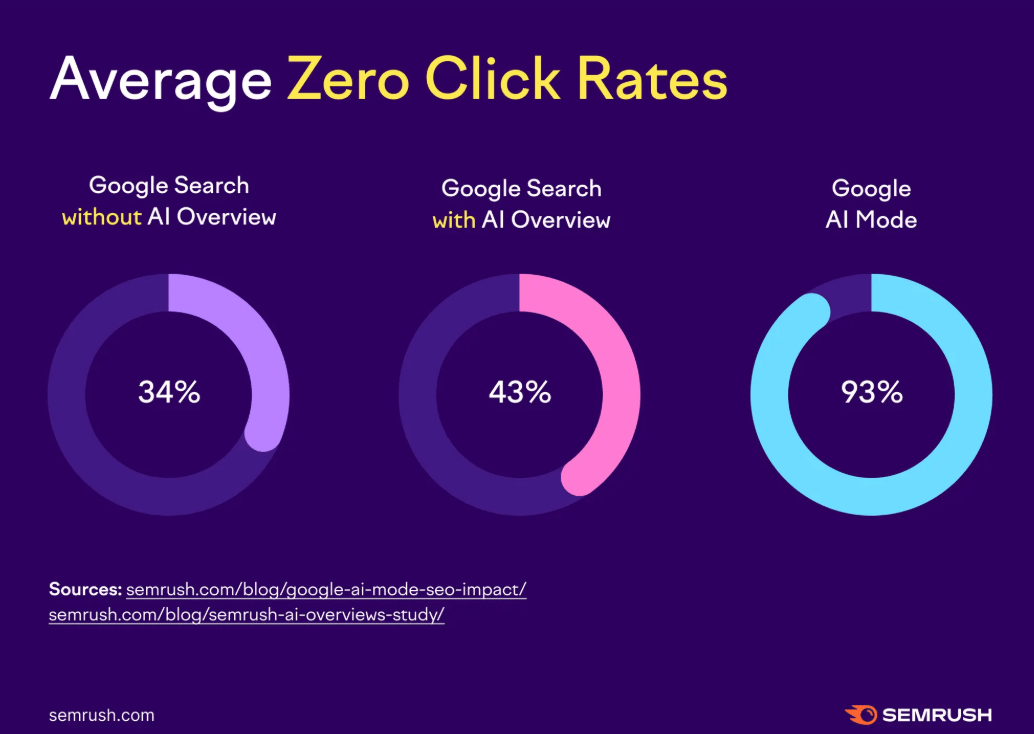
For a New Zealand business relying on organic traffic to drive leads, this is a critical vulnerability. The click-through rate (CTR) for organic search results is already showing signs of decline as "AI Overviews" and featured snippets answer queries instantly.
The Rise of the Machine Customer
The most profound, yet often overlooked, shift in this scenario is the emergence of "Agentic AI." As we move through 2026, marketers must consider the possibility that the "customer" visiting a website is not a human, but an AI agent acting on a human's behalf. These autonomous agents will be tasked with researching products, comparing specifications, negotiating prices, and even executing purchases without human intervention.
Consider a scenario where a procurement manager in Auckland asks their AI assistant to "find the best accounting software for a small construction firm in Christchurch." The agent will not read your emotionally charged brand story or appreciate your hero banner. It will scan your site for structured data, clear pricing tables, verified peer reviews, and "machine readability". If your site is technically optimized for a human eye but structurally opaque to an LLM, you effectively do not exist to the machine customer. This demands a pivot from Search Engine Optimisation to what experts are calling "Search Graph Optimisation" or "Answer Engine Optimisation" (AEO).
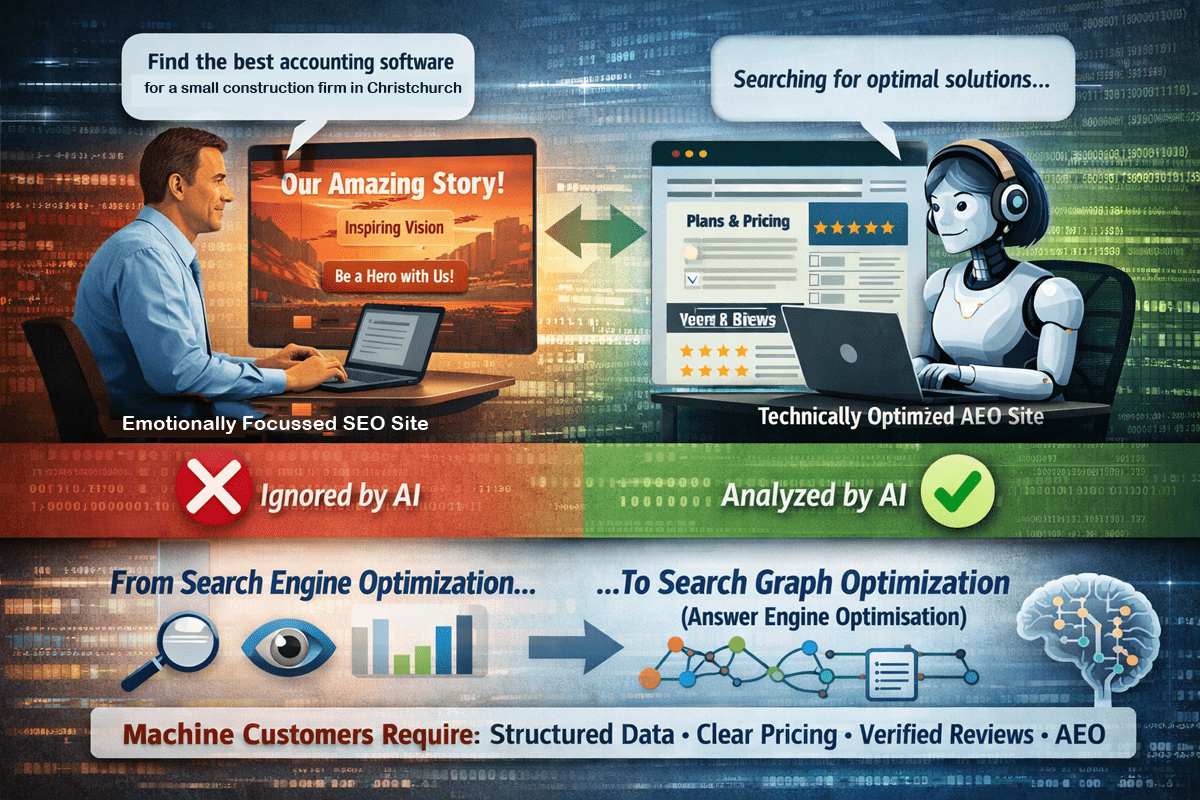
Of course, that doesn't mean that the brand story is unimportant, you still need that magic to close the sale with the humans who make the final decisions. You need both.
The Credibility Crisis and Citations
In an environment where answers are synthesized, the currency of the web shifts from "links" to "citations." An AI model builds its answer based on consensus and authority. Therefore, being cited as a trusted source by government bodies, industry associations, or major news outlets becomes more valuable than a thousand low-quality directory backlinks. This aligns with the E-E-A-T (Experience, Expertise, Authoritativeness, and Trustworthiness) framework, which Google and other AI developers are doubling down on to combat misinformation.
Strategic Implications for NZ Marketers
If search becomes agentic and conversational, the implications for NZ marketing strategies are severe and immediate:
|
Traditional SEO Focus |
2026 Agentic Discovery Focus |
|
Keyword density and placement |
Entity recognition and semantic context |
|
Backlinks from any domain |
Citations from authoritative, trusted sources |
|
Human-readable content (Visuals) |
Machine-readable content (Schema/Structured Data) |
|
Click-Through Rate (CTR) |
Share of Answer / Share of Model |
|
Traffic Volume |
Verification and Accuracy |
Actionable Insights:
- Audit for Machine Readability: NZ businesses must implement robust schema markup across their digital assets. Ensure your pricing, stock levels, and service areas are explicitly defined in code, not just text.
- Digital PR as the New Link Building: Focus on getting your brand mentioned and cited in high-authority New Zealand publications (e.g., Stuff, NZ Herald, industry journals). These mentions feed the "Knowledge Graph" that AI agents rely on.
- Optimize for Questions, Not Just Keywords: Shift content strategy to answer specific questions directly and concisely (approx. 40-60 words). This increases the likelihood of being picked up as the "direct answer" by voice assistants and AI chats.
#2: What If IPP 3A Makes Third-Party Leads 'Toxic' and Forces a Return to Radical Transparency?
The Regulatory Cliff Edge: May 1, 2026
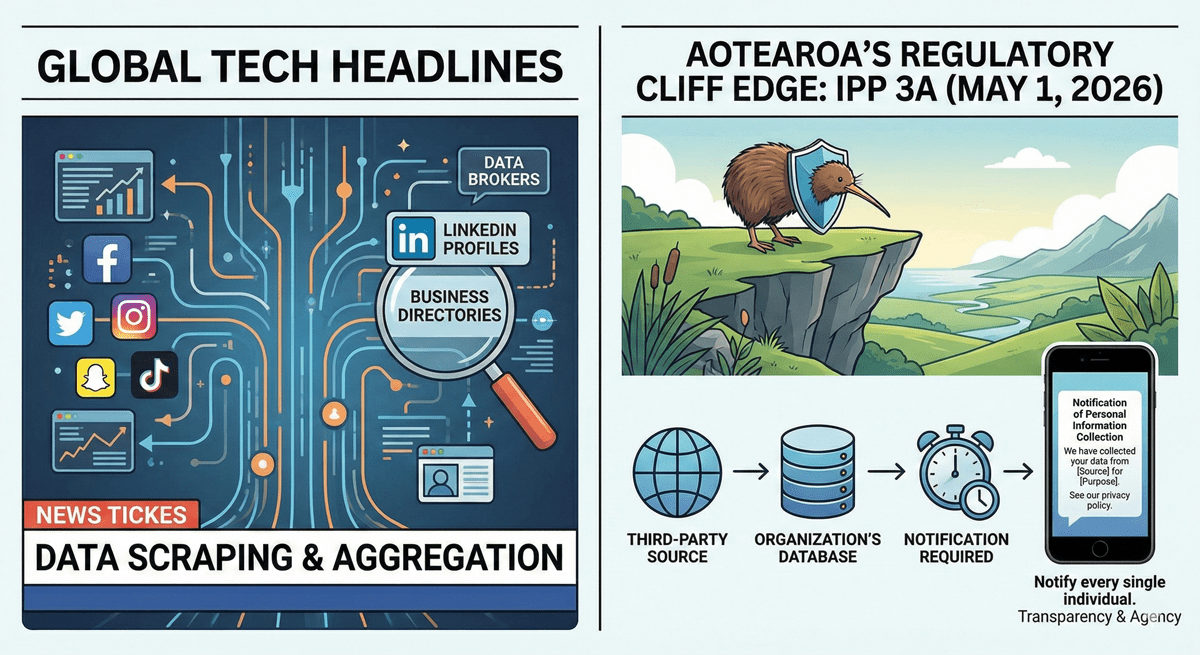
While global tech trends often grab headlines, a legislative change specific to Aotearoa is set to fundamentally rewire local marketing operations. The introduction of Information Privacy Principle 3A (IPP 3A), effective from May 1, 2026, mandates that organizations must notify individuals when their personal information is collected from third-party sources. This is not a minor adjustment; it is a regulatory cliff edge for any business reliant on data aggregation or list buying.
Under IPP 3A, a business acquiring personal data must notify every single individual that they have their data, where they got it, and why they have it—"as soon as reasonably practicable".
This principle applies to "indirect collection" broadly. This includes data scraping from public sources like LinkedIn or business directories. If a sales team scrapes 100 profiles for outreach, the organization is legally obligated to inform those 100 people that their data has been collected. This aligns New Zealand's privacy framework closer to the GDPR but with specific local nuances that prioritize transparency and individual agency over data control.
The "Permission Marketing" Renaissance
This legislative shift forces a return to the principles of "Permission Marketing," a concept championed by Seth Godin decades ago but now codified into NZ law. Godin's assertion that "Permission is priceless" moves from a strategic ideal to a legal necessity. Marketing in 2026 must be "anticipated, personal, and relevant."
Marketers will have to abandon "spray and pray" tactics and invest heavily in inbound marketing mechanisms that encourage users to volunteer their data. The value exchange must be clear: the user provides their data in return for genuine value (content, utility, entertainment), not just the privilege of being marketed to.
Strategic Response: The First-Party Imperative
The only safe harbor in this new regulatory environment is first-party data. NZ businesses must own their audience relationships directly.
- The Gold Rush for First-Party Data: We will see a surge in high-value "lead magnets"—interactive tools, calculators, exclusive industry reports—that compel users to hand over their data voluntarily. The "gate" for content must offer sufficient value to overcome the consumer's rising privacy consciousness.
- Contextual Advertising Returns: With audience targeting via third-party cookies largely deprecated and third-party lists regulated, advertising will swing back to context. Placing ads where the audience is (e.g., a local trade publication or a specific niche website) becomes safer and more effective than chasing user IDs across the web.
- Trust as a Differentiator: Compliance with IPP 3A shouldn't just be seen as a legal hurdle; it is a brand asset. Companies that are transparent about data lineage ("We only have your data because you gave it to us") will build higher trust capital than competitors relying on opaque acquisition methods. Trust is the new currency of the digital economy.
#3 What If Retail Media Networks Become Aotearoa's Dominant Advertising Channel?
The Shift from "Trade Spend" to "Media Spend"
For decades, FMCG (Fast-Moving Consumer Goods) brands in New Zealand negotiated "trade spend" to secure better shelf placement in supermarkets. By 2026, this dynamic has evolved into significant dominance by Retail Media Networks (RMNs). Major players like The Warehouse Group (MarketMedia), Woolworths (Cartology), and Foodstuffs (Precision Media) are transforming their digital and physical real estate into sophisticated advertising platforms.
This trend is not merely about placing banner ads on an e-commerce site. It represents a fundamental shift in where advertising budget is allocated. Global forecasts suggest that RMNs are growing at 15-20% year-on-year, significantly outpacing traditional media channels. In New Zealand, a market duopoly in grocery and a consolidated retail sector creates a uniquely powerful environment for these networks to thrive.
Purchase Data
RMNs offer a lifeboat of rich, deterministic first-party customer data. Retailers know what Kiwi families actually buy, not just what they search for or "like" on social media. This purchase data is the "holy grail" of attribution.
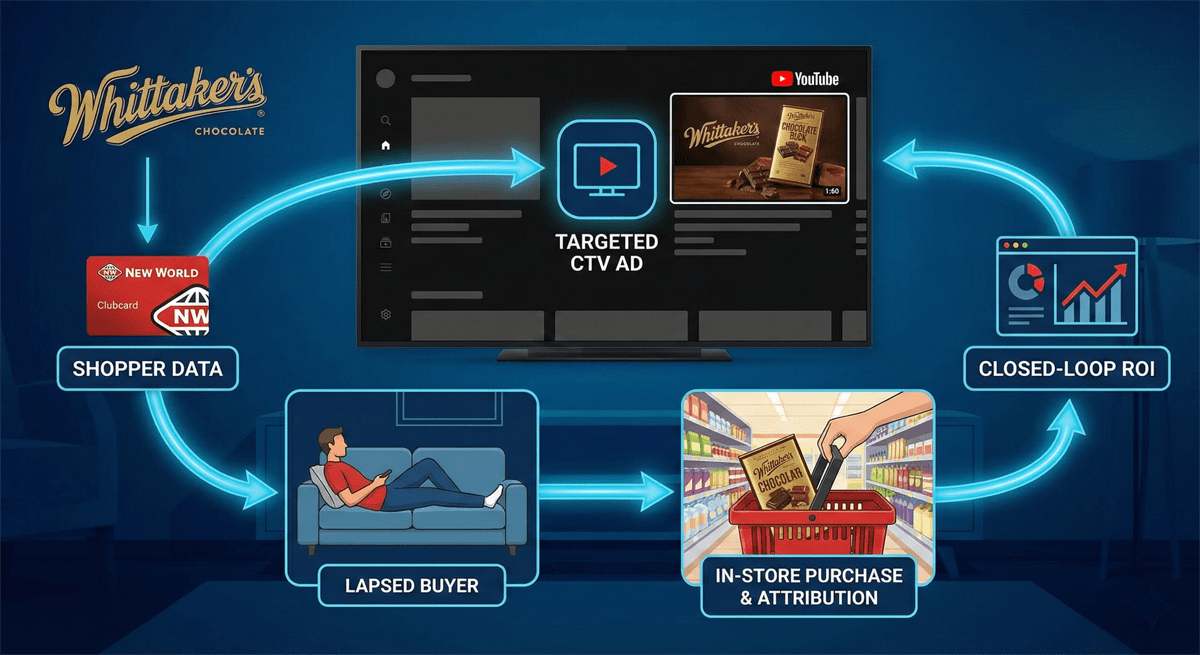
In the short to medium term, we might reasonably expect these networks to expand "off-site." What if a brand like Wattie's or Whittaker's could (potentially) use Foodstuffs' shopper data to target ads on CTV (Connected TV) platforms like TVNZ+ or YouTube? For example, if appropriate systems are in place, what if they could eventually be able to target "lapsed buyers of premium chocolate" with a video ad on YouTube, and then track exactly how many of those viewers bought the product in-store at New World the following week? Compliance challenges are massive, especially under IPP3A, but what if this was possible? This "closed-loop" attribution, if available, would solve the biggest headache in digital marketing: proving ROI.
Implications for NZ Brands
The rise of RMNs fundamentally alters the relationship between retailers and suppliers. It creates a "pay-to-play" environment where visibility on the "digital shelf" is auctioned.
- The Rise of "Brandformance": The distinction between brand building (awareness) and performance marketing (sales) blurs within RMNs. A display ad on The Warehouse's website builds brand awareness and sits just one click away from a purchase. This dual utility drives efficiency in marketing budgets.
- Data Collaboration via Clean Rooms: This might lead to the widespread adoption of "Data Clean Rooms" where brands and retailers share data securely to map customer journeys without violating privacy laws. This technology allows for granular analysis of campaign performance while protecting individual user identities.
- Competition for Digital Shelf Space: The battleground for visibility moves from the physical aisle to the search results within a retailer's app. "Retail Search" becomes a primary SEO discipline. Brands must optimize their product titles, images, and descriptions to rank within the retailer's internal search algorithms, which are often distinct from Google's.
Major NZ Retail Media Players & Capabilities
|
Network |
Retail Brands |
Key Strengths |
2026 Trajectory |
|
MarketMedia |
The Warehouse, Noel Leeming, Warehouse Stationery |
Integrated reach across general merchandise & electronics; strong first-party data. |
Expanding off-site reach; unified audience view across brands. |
|
Cartology |
Woolworths NZ |
Granular grocery shopper data; connection to Everyday Rewards. |
Focus on omnichannel attribution and "off-network" partnerships. |
|
Precision Media |
Foodstuffs (New World, PAK'nSAVE) |
"DunnHumby" partnership for advanced data science; scale of cooperative network. |
leveraging "closed loop" measurement to prove in-store sales lift. |
#4: What If 'Content at Scale' Floods the Web, Making Human Creativity the Ultimate Premium?
The Deluge of AI "Slop"
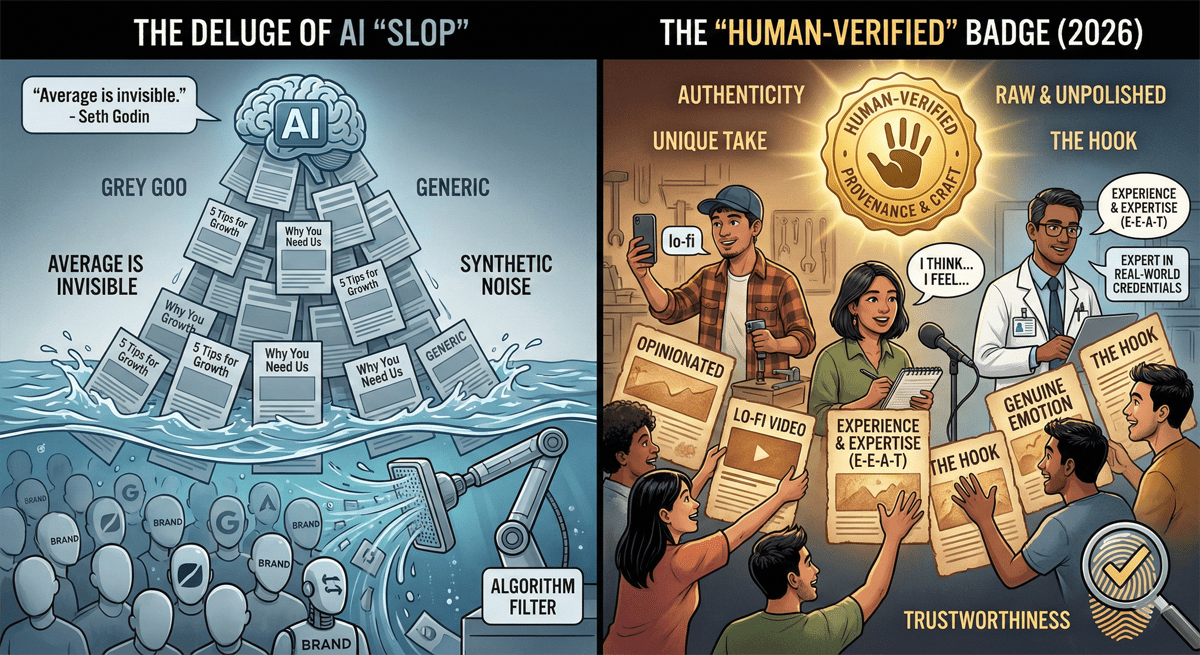
The barrier to creating content is now effectively zero. Generative AI tools allow any business, regardless of size, to produce thousands of blog posts, social media updates, and marketing emails in minutes. The inevitable result is a digital ecosystem flooded with what industry commentators call "grey goo" or "AI slop"—competent, grammatically correct, but utterly generic content.
In this scenario, the "What If" is a crisis of relevance. If NZ businesses use the same AI tools (ChatGPT, Claude, Gemini, Jasper) with the same prompts to target the same keywords, they will produce indistinguishable brand voices. As marketing thought leader Seth Godin presciently notes, "Average is invisible". In a sea of AI-generated average, being "safe" and "professional" becomes the riskiest strategy of all. The algorithm, and the human eye, will learn to filter out the synthetic noise.
The "Human-Verified" Badge
The counter-trend for 2026 will be a massive premium on "provenance" and "craft." Audiences, fatigued by synthetic media, will gravitate toward content that signals human effort, lived experience, and genuine emotion. Authenticity becomes a verifiable asset.
- Opinionated Content: AI is excellent at summarizing consensus; it is terrible at having a contrarian opinion or a unique "take." Kiwi brands that take a stand, express a strong point of view, or share raw, unpolished behind-the-scenes content will cut through. Content that says "I think" and "I feel" will outperform content that says "Here are 5 tips".
- The Return of "Lo-Fi": We are already witnessing the dominance of "lo-fi" video on platforms like TikTok and Reels. This is content that feels shot on a phone by a real person, not a production studio. In 2026, high production value may actually signal "inauthentic" or "ad" to younger consumers, triggering ad blindness. The rough edge is the hook.
- Authorship and Expertise (E-E-A-T): Google's algorithms will aggressively prioritize content with clear Experience, Expertise, Authoritativeness, and Trustworthiness. A blog post by a named NZ expert with a traceable digital footprint and real-world credentials will vastly outperform an anonymous, AI-generated guide. The "About Us" page and author bios become critical SEO assets.
Strategic Pivot: From Volume to Voice
Marketers in 2026 must stop asking, "How can AI help me write more?" and start asking, "How can AI help me think better, so I can write something only I could write?". Ann Handley, a leading voice in content marketing, argues that in an AI world, "Your voice is your differentiator." The goal shifts from "content at scale" to "connection at scale."
Recommendation: Adopt a "Hybrid Content Model." Use AI for the heavy lifting of research, structure, and repurposing (e.g., turning a video into a blog post), but ensure the "last mile"—the tone, the stories, the opinions—is exclusively human.
#5: What If The Sales Funnel Dies, Replaced by 'Dark Social' and Peer-to-Peer Trust?
The Dark Funnel Reality
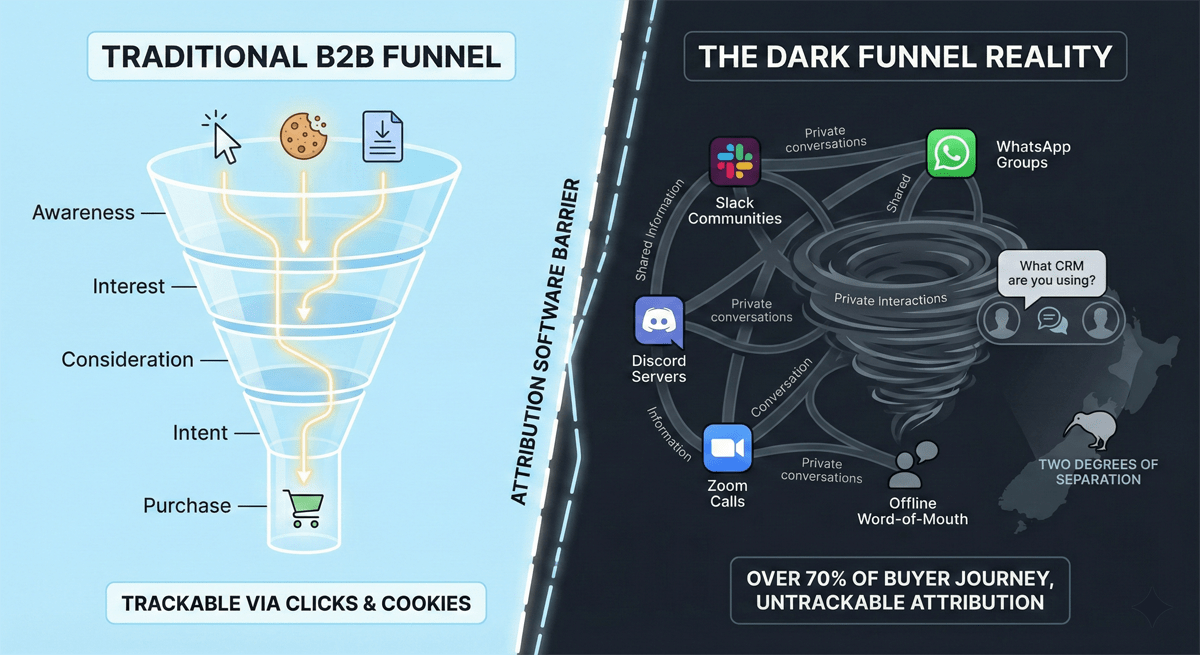
The traditional B2B marketing funnel—Awareness -> Interest -> Consideration -> Intent -> Purchase—assumes a linear path that can be tracked via clicks, cookies, and form fills. This model is now in many cases obsolete. Research indicates that the vast majority of the buyer journey (over 70%, and potentially higher in niche B2B sectors) happens in the "Dark Funnel" or "Dark Social".
"Dark Social" refers to the private sharing channels that attribution software cannot see: Slack communities, WhatsApp groups, Discord servers, Zoom calls, and offline word-of-mouth. In New Zealand, a market that relies heavily on networks and "who you know" (the "two degrees of separation"), this effect is amplified. A decision-maker at a large NZ business is far more likely to ask a peer in a private industry forum, "What CRM are you using?" than to click a Google Ad and download a whitepaper.
Marketing in the Shadows
If 70-80% of the buying decision happens before a vendor is even contacted, marketing must shift from "capturing demand" (via ads) to "generating demand" inside these communities. This requires a fundamental change in tactics.
- Community as a Strategy: Brands need to move from broadcasting to facilitating. This might mean hosting private dinners for industry leaders, sponsoring niche communities without demanding lead lists, or empowering internal subject matter experts to be active participants in these spaces. The goal is to be the "most helpful voice in the room," not the loudest.
- The Employee as Influencer: People trust people, not logos. NZ companies will increasingly encourage their employees to build personal brands on LinkedIn. An engineer at a Kiwi SaaS company sharing technical insights is more effective marketing than the corporate account sharing a press release. This "employee advocacy" scales trust in a way paid ads cannot.
- Ungated Content: If you gate your best content behind a form, it won't get shared in a Slack group. The friction is too high. Today's strategy is to set content free to travel through the dark funnel, trusting that the consumption of value will eventually drive inbound demand. The metric shifts from "leads generated" to "consumption" and "engagement".
Measuring the Unmeasurable
How do you measure Dark Social? You can't track it perfectly, but you can triangulate it.
- Self-Reported Attribution: Adding a "How did you hear about us?" field to high-intent forms (like demo requests) captures the qualitative data that software misses (e.g., "heard about you on a podcast" or "recommended by a friend in Slack").
- Direct Traffic Analysis: A spike in direct traffic to a specific blog post or landing page often indicates it is being shared in private channels (email, chat apps) where the referrer data is stripped.
#6: What If The Māori Economy Becomes the Primary Engine of Brand Distinctiveness?
The Taniwha Economy Roars
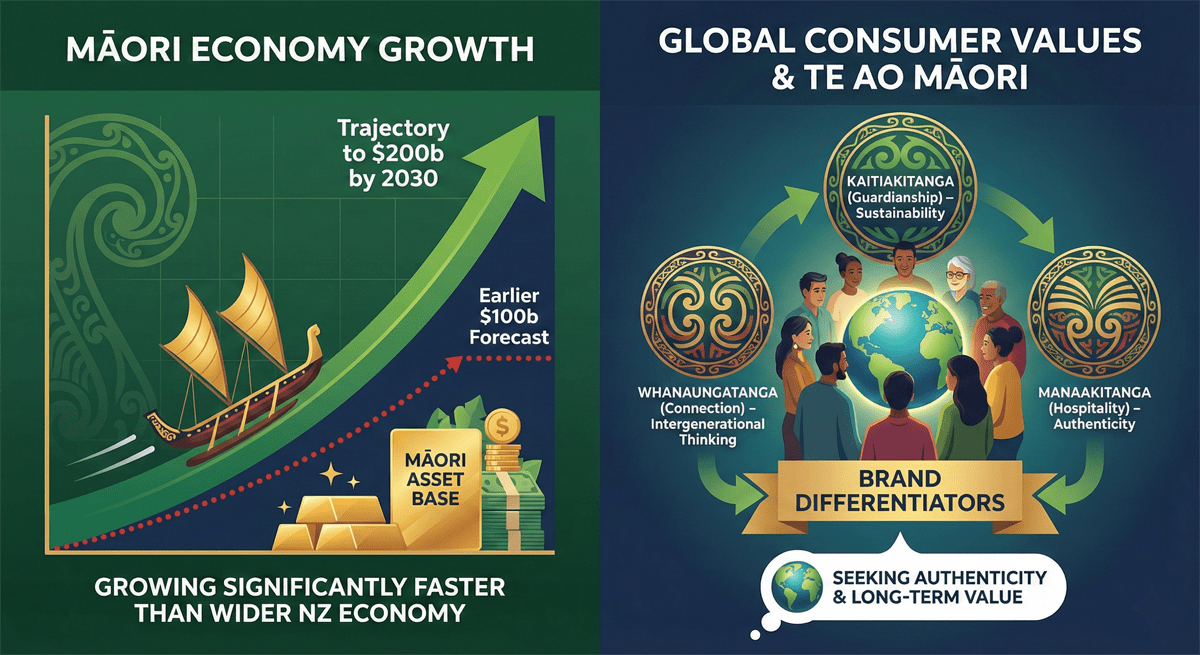
The Māori economy is growing significantly faster than the wider New Zealand economy. On current trajectories, some analyses suggest the Māori asset base could approach or exceed $200b by 2030, materially ahead of earlier $100b forecasts.
Global consumers are increasingly seeking authenticity, sustainability, and intergenerational thinking—values that are inherent in Te Ao Māori (the Māori worldview). Concepts like Kaitiakitanga (guardianship), Whanaungatanga (connection/relationships), and Manaakitanga (hospitality/care) are not just cultural principles; they are powerful brand differentiators in a world obsessed with short-termism and extraction.
Integrating Cultural Authenticity
For mainstream NZ marketers, the "What If" challenge is how to authentically engage with this shift without falling into tokenism or appropriation. The risk of "cultural washing" is high, and the backlash can be severe.
- Partnership vs. Appropriation: Successful brands in 2026 will co-design with Māori, forming genuine partnerships with Iwi and Māori-owned businesses. It’s about "doing with," not "taking from." This aligns with the principles of Te Tiriti o Waitangi and creates shared value.
- Bicultural Competency as a Core Skill: Understanding Te Reo Māori and Tikanga will cease to be a "nice-to-have" and become a core competency for marketing teams. Government procurement and major corporate tenders will increasingly require demonstrable commitment to these values. We are already seeing AI tools being used to translate content into Te Reo Māori at scale, but human oversight remains critical to ensure cultural safety.
- Export Advantage: International markets, particularly in Asia and Europe, are fascinated by indigenous storytelling. NZ exporters who authentically weave this narrative (like Kono, Miraka, or even Air New Zealand) find a premium position that generic "clean green" branding no longer provides. The narrative shifts from "products from a place" to "products with a people and a purpose".
#7: What If TikTok Becomes the Primary Search Engine for Under-40s?
The Visual Search Revolution
Traditional search isn't only under attack by AI. The phrase "Just Google it" is being replaced by "Search it on TikTok" for a growing demographic. Research indicates that for Gen Z and younger Millennials, platforms like TikTok and Instagram are the first port of call for discovery. They are turning to these platforms not just for entertainment, but for utility: finding a restaurant in Wellington, learning how to fix a leaky tap, or reviewing a new beauty product.
This shifts the SEO paradigm from text-based crawling to video-based discovery. "Social Search" optimization becomes a critical skill for 2026. The algorithm on TikTok is no longer just about "virality"; it is about "relevance" to a search query.
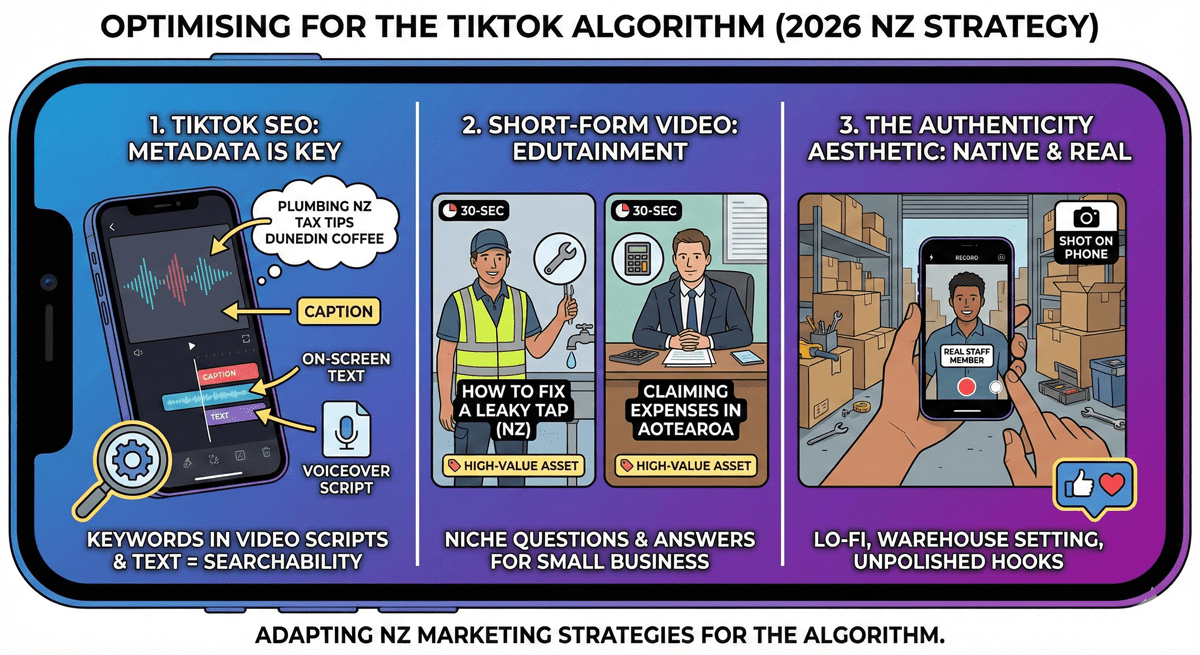
Optimising for the TikTok Algorithm
To win in this environment, NZ marketing strategies must adapt:
- TikTok SEO: Marketers must treat video captions, on-screen text, and voiceovers as metadata. If the algorithm can't "hear" or "read" the keywords in your video, it won't surface it in search results. This means keyword research now applies to video scripts.
- Short-Form Video as Education: The trend is moving from "dance trends" to "edutainment." NZ small businesses—plumbers, lawyers, accountants—can win by answering specific, niche questions in 30-second video formats. "How to claim expenses in NZ" or "Best coffee spots in Dunedin" become high-value video assets.
- The Authenticity Aesthetic: High-performing content in 2026 often looks like it was shot on a phone, in a warehouse, by a real staff member. It feels native to the platform, not an interruption. This lowers the barrier to entry for small businesses but raises the bar for creativity and "hook" ability.
Search Behaviour Shift
|
Feature |
Google (Traditional) |
TikTok / Instagram (Social Search) |
|
Primary Format |
Text / Links |
Video / Visuals |
|
Trust Signal |
Domain Authority / Backlinks |
Creator Relatability / Social Proof (Comments) |
|
User Intent |
Informational / Transactional |
Discovery / Experiential / Verification |
|
NZ Context |
"Best cafes Auckland" (Listicle) |
"Best cafes Auckland" (Video walkthroughs) |
#8: What If 'Greenwashing' Enforcement Becomes an Existential Threat to Brand Trust?
The End of "Eco-Fluff"
New Zealand consumers are becoming increasingly sceptical, and regulators are sharpening their teeth. The days of slapping "eco-friendly," "sustainable," or "farm-fresh" on a label without rigorous, accessible proof are long gone.
This regulatory environment creates a high-stakes landscape for marketing strategies. A single misleading claim can lead to significant fines, legal action, and—most damagingly—a permanent loss of consumer trust.
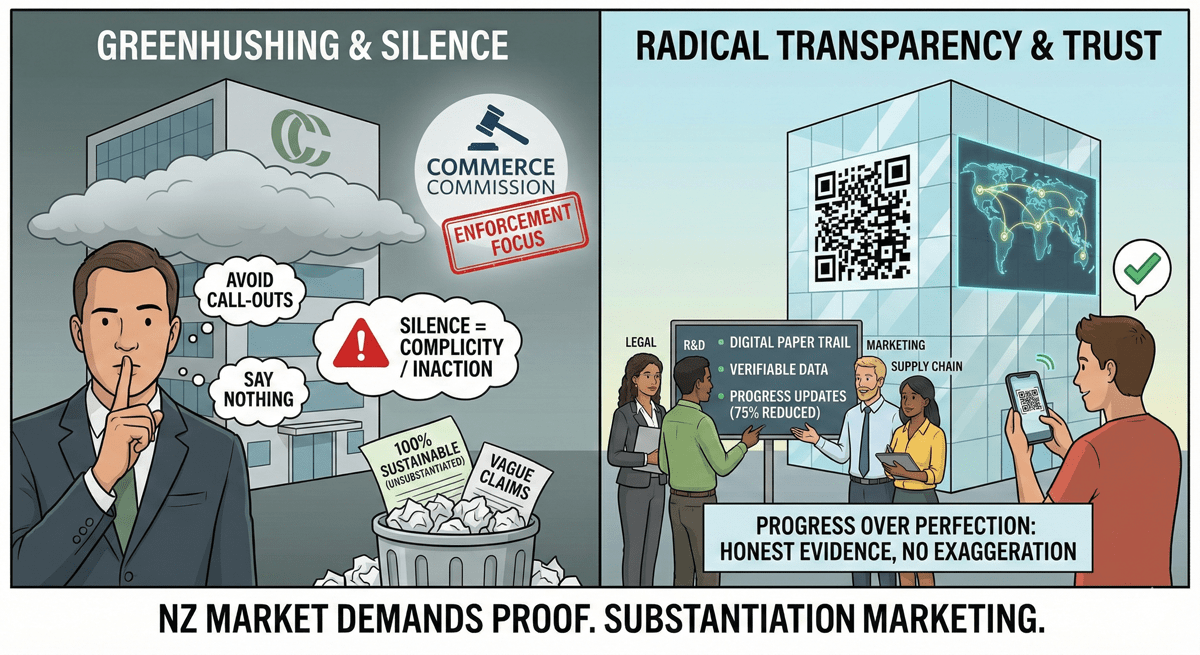
The "Greenhushing" vs. Radical Transparency Risk
Brands may be tempted to engage in "greenhushing"—saying nothing about their sustainability efforts to avoid the risk of being called out. However, the market demands progress. Silence is often interpreted as complicity or inaction. In a market where consumers expect proof and regulators are targeting misleading claims, brands that lean into transparency about progress and limits are better positioned than those that stay silent.
- Substantiation is Marketing: Marketing teams must work lock-step with legal, R&D, and supply chain teams. Every claim must have a "digital paper trail" accessible to the consumer. Technologies like QR codes that link to verifiable sourcing and footprint data are emerging as powerful trust signals and are likely to become increasingly common, especially in higher‑involvement categories.
- Progress over Perfection: Consumers forgive imperfection; they punish deception. They increasingly expect honest, evidenced progress updates and are far less forgiving of exaggerated or unsubstantiated “100% sustainable” claims than of transparent work‑in‑progress.
- Local Enforcement Priority: The NZ Commerce Commission has recently taken action on alleged greenwashing and reiterated that environmental claims must be accurate and substantiated, signalling a heightened enforcement focus even where “greenwashing” is not listed as a stand‑alone named priority.
#9: What if “Brand” Became a Data Problem?
Does your data reflect your brand values?
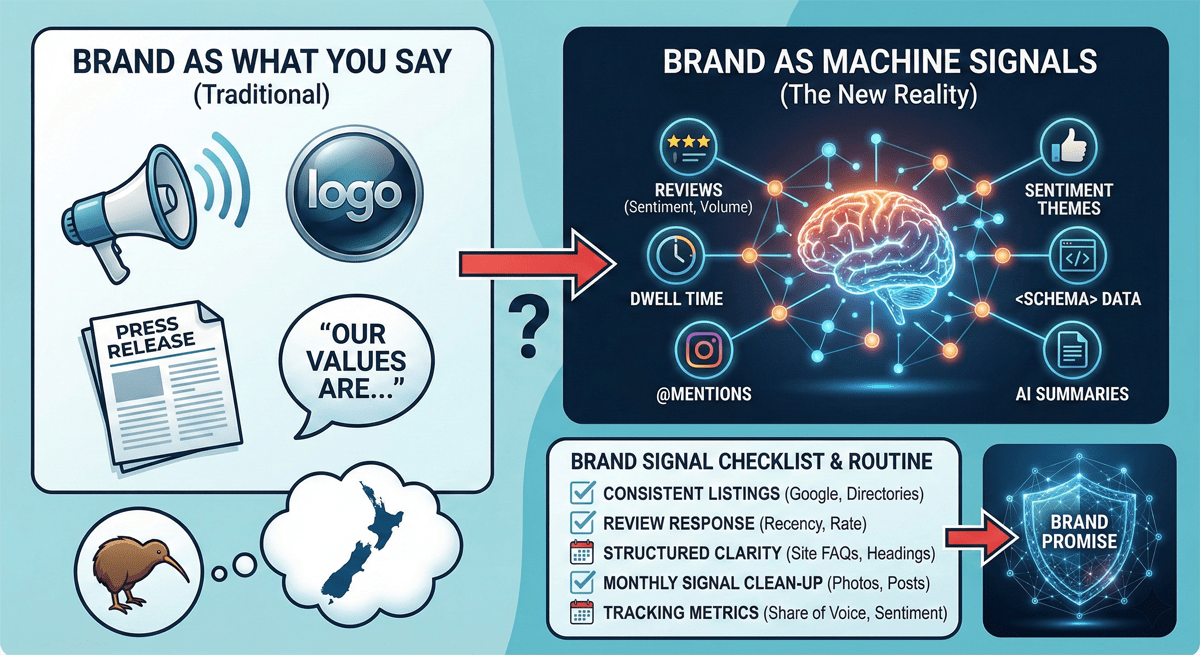
We've already talked about adding in the necessary data to ensure you rank more effectively if machines come to call. But what if the strength of your brand in New Zealand was defined less by what you say and more by what every system infers about you — reviews, dwell time, sentiment, structured data, mentions, and AI summaries? Would you treat brand-building as a data-quality and signal-consistency challenge across platforms as much as a comms challenge?
Ensuring Data Supports Your Brand
- Create a brand signal checklist across platforms: business name, category, descriptions, offers, pricing cues, proof, images, FAQs — keep it consistent.
- Fix the basics that machines infer from: reviews (volume + recency), response rate, sentiment themes, and accuracy of listings.
- Set up a monthly “signal clean-up” routine: update Google Business Profile posts, refresh photos, respond to reviews, correct directory listings, check inconsistent claims.
- Add structured clarity on your site (even if it’s not your main channel): clear headings, FAQs, schema where relevant, and pages that AI can summarise correctly.
- Track “brand as signals” metrics: share of positive reviews, star rating trend, branded search volume, sentiment keywords, and mention quality.
#10: What If Trust in Traditional News Media Collapses, Replacing 'Reach' with 'Resonance'?
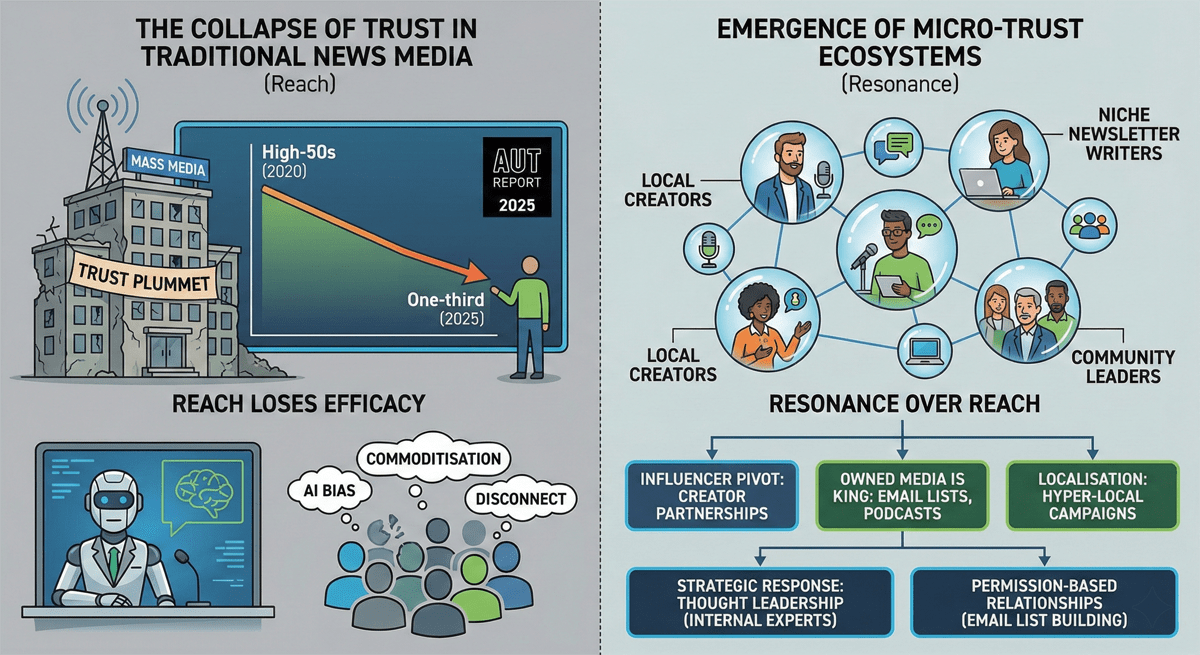
What if the decline in trust in traditional news media accelerates to a breaking point? Only a minority of New Zealanders trust mainstream news outlets, driven by perceptions of bias, the "commoditisation" of news via AI, and a general disconnect from community values. Mass media advertising loses its efficacy as audiences fragment. Instead, "micro-trust" ecosystems emerge. Consumers place their faith in individual voices—local creators, niche newsletter writers, and community leaders—over large institutions.
The Driver: The Trust Plummet
The AUT Trust in News 2025 report shows trust in news has fallen from the high‑50s in 2020 to around one‑third in 2025, even as trust in other institutions has not declined as steeply. Around 60% of New Zealanders say they are uncomfortable with news mostly produced by AI, creating a clear trust risk for media outlets that lean heavily on automation. Conversely, as trust in institutions lags, audiences increasingly look to individual creators, local leaders and niche communities they feel know and reflect their values, even if hard data on this shift is still emerging.
Implications for NZ Businesses
- The Influencer Pivot: "Influencer marketing" matures into "Creator Partnerships." It’s no longer about buying a one-off shout-out; it’s about establishing long-term ambassadorships with creators who hold the trust of niche communities. These creators become the primary distribution channel for brand messages.
- Owned Media is King: Brands must become their own media companies. Reliance on "rented land" (social algorithms) or "dying land" (traditional media) is a high-risk strategy. Email lists, podcasts, and proprietary content hubs become the most valuable assets a company possesses. The focus shifts to "zero-click" content that provides value within the platform, building authority and trust.
- Localisation: National campaigns fail; local campaigns succeed. Marketing needs to be hyper-localised to resonate with specific community values and concerns. The "one size fits all" approach is dead.
Strategic Response
Companies must invest in thought leadership within their own teams. Elevating internal experts to be the public face of the brand humanises the organisation and builds direct trust. Building an email list aggressively is the only hedge against algorithm changes and media fragmentation.
In a low‑trust media environment, permission‑based relationships and credible human faces become core assets; when news media cannot or will not tell your story, your brand needs to cultivate its own trusted channels and storytellers.
#11: What If Your Best Customers Never Visit Your Website?
Do you control your messaging?
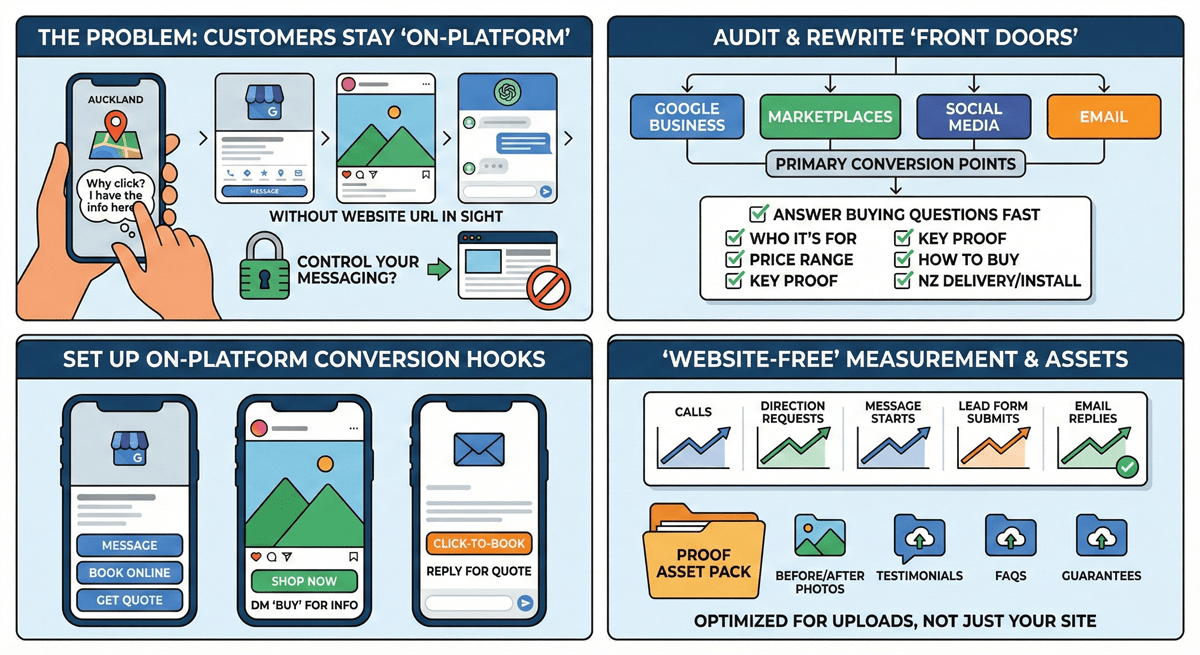
What if (and it may be happening already) most of your high‑value NZ customers experience your brand almost entirely through Google Business, marketplaces, social, AI answer engines, and email — but rarely click through to your domain? How would that change where you invest content, measurement, and UX effort, and what “on‑platform” conversion looks like for you?
Consider these preventative measures
- Audit your “front doors”: Google Business Profile, key marketplaces, LinkedIn/Instagram/Facebook, email, and anywhere you get discovered — treat these as primary conversion points.
- Rewrite your profiles to answer buying questions fast: who it’s for, price range, key proof, how to buy, how fast delivery/install works in NZ.
- Set up on-platform conversion hooks: GBP messaging, appointment links, quote forms, shop links, lead forms, DM keywords, email click-to-book.
- Create “website-free” measurement: track calls, direction requests, message starts, lead form submits, and email replies as real conversions.
- Make a small proof asset pack (before/after, testimonials, FAQs, guarantees) optimised for platform uploads, not just your site.
#12: What If Mandatory AI Literacy Becomes a Condition of Employment?
The Upskilling Imperative
This year, "proficient in Microsoft Office" will be replaced on CVs by "proficient in Generative AI prompting," "AI workflow automation," and "LLM governance." With reports showing a significant "productivity divide" between those who use AI and those who don't, NZ employers may begin mandating AI literacy training as a condition of employment or advancement.
It's already happening.
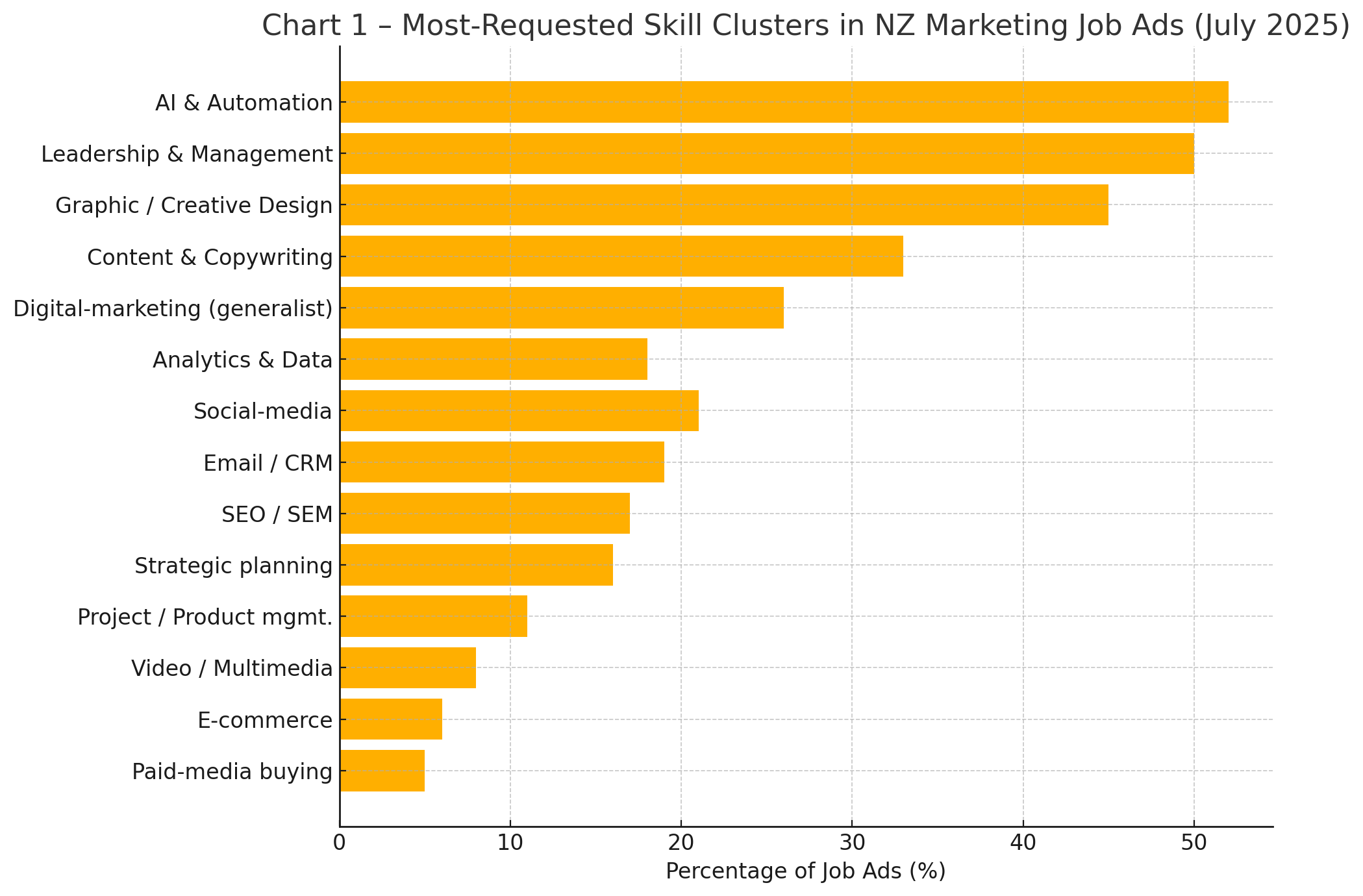
Our own research into NZ Marketing Job Ads, conducted in July 2025, showed that AI is now the most sought-after skill for advertising and marketing jobs:
Other data confirms the trend:
- According to IDNZ, 75.8% of marketers see AI expertise as a major skills gap, but only 5% feel fully proficient
- The NZ Digital Marketing Institute reports that 75% of companies who use AI are moving teams toward high-level activities like planning and innovation
Bridging the Gap
To close this gap and remain competitive:
- Internal Academies: Agencies and large corporates (like Spark and One NZ) are already establishing internal "AI dojos" or certification programs to upskill their workforce rapidly. This trend will trickle down to SMEs.
- Hybrid Roles: We will see the rise of the "AI Marketing Specialist" or "AI Operations Lead"—someone who understands marketing strategy and the technical capability of AI tools to execute it. This requires a "comb-shaped" skill set: broad marketing knowledge with deep technical spikes.
- Change Management: The challenge isn't the tech; it's the culture. Leaders must create psychological safety for teams to experiment with AI without the fear that they are "automating themselves out of a job." The narrative must be "AI as co-pilot," not "AI as replacement".
And yes, we at Netmarketing Courses offer a range of AI courses, specifically designed to help marketers become effective AI practitioners (through our AI for Marketers course) and then grow to become AI marketing experts (through our Advanced AI for Marketers course).
Check out the details of our AI for Marketers online training course here.
Check out the details of our Advanced AI for Marketers online training course here.
We also offer specialist courses designed to help you use AI effectively for Retail Marketing, Tourism Marketing and Small Business Marketing.
More What Ifs
Been challenged enough?
No? Then try these additional thoughtstarters:
#13: What if your marketing stack had to shrink by 50%?
What if budget pressure or governance rules forced you to halve your martech tools in 2026, keeping only those tied directly to revenue, retention, or risk reduction? Which tools, reports, and processes would survive that cut — and what would that reveal about what actually drives outcomes for NZ marketers?
Do now
- Do a ruthless tool-to-outcome map: for every tool, write the revenue/retention/risk job it does. If you can’t name the job, it’s a candidate to cut.
- Identify your core four: analytics, CRM/email, ad platform(s), and one content/workflow tool. Aim to consolidate around these.
- Freeze new subscriptions for 60 days and run a “tool detox” test: turn off 20–30% of tools and see what breaks (and what doesn’t).
- Replace “nice dashboards” with one weekly scorecard: leads, pipeline influenced, conversion rate, CAC/CPA, retention/churn, gross margin.
- Document 5–10 minimum viable processes (campaign launch, reporting, lead handover, email sends) so you keep capability even when tools shrink.
#14: What If Employee-Generated Content Became the New Influencer Marketing for Kiwi Brands?
Suppose employees, not celebrities, drive brand narratives in 2026. For NZ companies, this could build authenticity, especially in sectors like tourism where local stories resonate.
Rory Sutherland quips, "The problem with logic is it kills magic," reminding us that genuine, unpolished content often outperforms polished ads. Encourage staff to share behind-the-scenes on social media, tying into NZ's community ethos.
Benefits include cost savings and higher engagement—track metrics like min_replies to refine. For small businesses in New Zealand, this strategy could enhance social media presence, driving real business outcomes through trusted voices.
#15: What if “zero party data” was your main creative brief?
What if every campaign brief in 2026 started with: “What valuable thing can we offer that motivates NZ customers to willingly share preferences, intent, or context with us?” How would that reframe lead magnets, quizzes, events, and loyalty activity as engines for consented insight rather than just short-term list growth?
Do now
- Start every campaign with a value question: “What will someone happily trade their preferences for?” (e.g., personalised plan, diagnostic, benchmark, calculator, deal alerts).
- Build one preference capture mechanism you can reuse: quiz, short assessment, “pick your priorities” form, or onboarding questions.
- Use a preference centre in email: let people choose topics, frequency, and interests (this reduces unsubscribes and lifts relevance).
- Tie data capture to an immediate payoff: the result, a tailored recommendation, a checklist, or a curated set of next steps.
- Store only 5–7 high-value fields that actually change marketing outcomes (avoid collecting trivia you won’t use).
#16: What if you optimised for “time to clarity” instead of “time on page”?
What if the success metric for your content marketing was how quickly a busy NZ customer could understand what to do next — not how long they stayed scrolling? Would that move you toward sharper headlines, tighter explanations, smarter internal linking, and clearer CTAs, even if traditional engagement metrics dropped?
Do now
- Rewrite your key pages and posts so the first screen answers: Who it’s for, what it does, what to do next (in plain language).
- Add a “TL;DR + Next steps” box near the top: 3 bullet summary + one primary CTA + one secondary CTA.
- Use decision headings, not poetic ones: “If you’re trying to ___, do this” beats clever titles.
- Build “clarity paths”: internal links like “Start here / Compare options / Pricing / Proof / How it works” so people can decide quickly.
- Change reporting: track CTA clicks, enquiries, bookings, and qualified leads as the win — not scroll depth.
#17: What If your AI tools disagreed with your strategy?
What if AI optimisation engines kept recommending tactics that clashed with your positioning — e.g., click‑bait creative or discounts that erode brand value — but delivered short-term gains? How would your NZ brand codify non‑negotiables, so AI is judged not just on conversion-rate lifts, but on whether it reinforces who you want to be in the market?
Do now
- Write 5–10 brand non-negotiables (pricing discipline, tone, claims you won’t make, discount limits, channels you won’t use, customer types you won’t chase).
- Create an AI guardrail checklist for campaigns: “Does this strengthen positioning? Does it protect margin? Does it attract the right customer?”
- Run AI ideas through a two-score test: short-term lift (conversion) and long-term fit (brand + margin + retention). Require passing both.
- Build a small approved message library (offers, proof points, differentiation) so AI is generating within your strategic lane.
- Put a human in charge of trade-offs: nominate a Brand Owner role who can veto tactics even if they test well.
#18: What if every NZ marketer had a personal “shadow P&L”?
What if each marketer had a simple, personal profit-and-loss view showing how their decisions, tests, and experiments contributed to pipeline and margin over the year? Would that make experimentation with AI, creative, and targeting more disciplined and bolder at the same time, because everyone could see their own financial impact?
Do now
- Give each marketer a simple monthly view: spend, leads/MQLs, sales accepted leads, pipeline value, closed revenue, gross margin estimate.
- Assign ownership by growth loop, not channel: acquisition loop, activation loop, retention loop, referral loop.
- Create a small experiment budget per person (even $200–$1,000/month) with a rule: document hypothesis, cost, result, next move.
- Add one margin-protecting metric: discount rate, AOV, churn, or payback period so growth isn’t bought at any price.
- Celebrate “good losses”: reward smart tests that failed fast and produced a clear learning.
#19: What if “trust scoring” becomes part of ad delivery?
Platforms could quietly favour advertisers with stronger proof signals: verified business identity, consistent claims, transparent offers, fewer complaints, clearer provenance.
Do now:
- Tighten offer terms, reduce ambiguity, build a proof library (reviews, case studies, third-party validation), and keep brand details consistent everywhere.
#20: What if the winning channel is the one you think is boring: invoices, statements, and service emails?
As paid attention gets pricier, the highest-open-rate messages are often transactional. They can carry helpful content, cross-sells, loyalty prompts, and referrals without feeling spammy.
Do now:
- Audit transactional comms. Add one useful module (tips, next best action, referral, add-on) and test it like a campaign.
#21: What if deepfake fraud forces “verification marketing” to become a new category?
Scams using fake founders, fake staff, or fake endorsements can spread fast in a small country. Trust may shift to brands that can prove identity and authenticity quickly.
Do now:
- Lock down verified social accounts, add clear “how to spot scams” guidance, use consistent spokesperson visuals, and create a simple verification page.
#22: What if customers start treating their data like an asset and demand payment (or real value) for it?
A shift from “give us your email” to “what do I get back, every time?” can accelerate. Loyalty could become a two-way contract.
Do now:
- Rebuild lead magnets into ongoing value: member-only tools, priority support, price protection, or useful alerts. Make the trade-off obvious.
So what should you make of all this?
This year for New Zealand marketers will not be defined by a single technology or trend, but by the convergence of intelligence, integrity, and intimacy.
- Intelligence: Leveraging artificial intelligence not just to create content, but to build autonomous agents that optimize the customer journey in real-time, anticipate needs, and execute tasks with superhuman speed.
- Integrity: Navigating a stricter privacy landscape (IPP 3A) and an intolerant regulatory environment for greenwashing by doubling down on transparency, first-party data, and verifiable claims.
- Intimacy: Countering the digital flood of "content at scale" with authentic, human-centric storytelling, deep engagement in "dark social" communities, and a genuine, respectful partnership with the Māori economy.
The "What If" scenarios outlined here are not distant science fiction; the signals are already present in the data. The legislative dates are set (May 1, 2026 for IPP 3A), the technology is deployed (Agentic AI), and the consumer shifts are visible (TikTok search). The marketers who thrive in 2026 will be those who stop waiting for the "old normal" to return and start building the infrastructure—technical, cultural, and strategic—for this new, dynamic reality today. As the saying goes in the tech sector: the future is already here, it's just not evenly distributed.
Time for us Kiwi marketers to grab our share of that future.
FAQ: Navigating the 2026 Landscape
Q: How can NZ businesses prepare for AI-driven search (GEO) without big budgets? A: You don't need a massive budget to optimize for AI. Focus on Experience, Expertise, Authoritativeness, and Trustworthiness (E-E-A-T). Ensure your website clearly answers common customer questions (Q&A format) and includes structured data (schema) so machines can understand your content. Focus on building a strong brand reputation through reviews and mentions in local media, as AI engines prioritize trusted entities over keyword stuffers.
Q: Will the new Privacy Act changes (IPP 3A) affect my existing email list? A: No, the changes are non-retrospective. IPP 3A applies to information collected after the commencement date (May 1, 2026). Historical databases collected before this date are "grandfathered." However, any new data acquired from third parties (e.g., list brokers, lead gen partners) after this date will require you to notify the individuals "as soon as reasonably practicable." It is crucial to audit your data collection sources now to ensure readiness.
Q: Is "Dark Social" really measurable? A: While you can't track it perfectly (that's why it's "dark"), you can infer it and triangulate it. Use "self-reported attribution" (e.g., a "How did you hear about us?" field on checkout/forms) to capture word-of-mouth. Also, monitor "Direct Traffic" to specific landing pages—if a long, specific URL gets direct visits, it was likely shared via a dark channel like WhatsApp or Slack rather than typed in manually.
Q: What is the single most important skill for a marketer to learn in 2026? A: AI Literacy combined with Strategic Empathy. You need the technical skill to operate AI tools (prompting, automation workflows, understanding agents), but you also need the uniquely human ability to understand why a customer cares and to tell a story that resonates emotionally—something AI still struggles to replicate authentically.
Q: Should we invest in TikTok if we are a B2B company? A: Yes. The lines between B2B and B2C are blurring. Decision-makers are people too, and they consume short-form video. "Edutainment" on platforms like TikTok or LinkedIn Video allows you to demonstrate expertise, answer questions, and build trust with stakeholders in a format they prefer. It is a powerful channel for humanizing a B2B brand.
Sources
tribegroup.com: Having survived 2025, It's time to thrive in 2026: What Kiwi ...
rnz.co.nz: ASB confident economy will turn around in 2026
mandr-group.com: The Future of SEO: How AI Is Changing Content Strategy in 2026
pipelinevelocity.com: Future of Search Trends & AI SEO: 2026–2027
searchengineland.com: 7 focus areas as AI transforms search and the customer journey in ...
id.ac.nz: 2026 ai Digital marketing trends & Insights report
indianexpress.com: Shark Tank India pitcher dropped IIM to build AI tool
kinetics.co.nz: Five Business IT Trends New Zealand Companies Should Watch in ...
business.google.com: Marketing predictions & guide for 2026
frontiermarketingllc.com: Digital marketing trends for 2026 - Frontier Marketing LLC
netmarketingcourses.co.nz: NZ Privacy Act Changes: Essential Email Marketing Compliance ...
4thoughtmarketing.com: Privacy Amendment Act: Changes by 2026
russellmcveagh.com: Privacy Amendment Act 2025 - Russell McVeagh
privacy.org.nz: Privacy Amendment Act passes
closethedeal.com: 40 Seth Godin Quotes on Marketing, Creativity, and Leadership
businesskiwi.com: Digital Marketing in NZ: 2026 Trends & Predictions for Success
stoppress.co.nz: The Warehouse Group unites media offerings with MarketMedia
marsunited.com: Retail Media Roundup: January 2026
thecurrent.com: Retail media is booming across APAC, from Indian metros to Kiwi ...
ovative.com: The 6 Marketing Trends to Watch in 2026 | Ovative Group
gotracksuit.com: The Tracksuit playbook: 5 tips to grow Future Demand in 2025
skai.io: Retail Media in 2026: Predictions From Industry Leaders
capgemini.com: Top retail trends 2026
annhandley.com: New Data Just Dropped: Blogging in 2025
smarketershub.com: 2026 marketing trends: insights from 6 industry experts
searchenginejournal.com: Google's Old Search Era Is Over – Here's What 2026 SEO Will ...
thewebcompany.digital: NZ Social Media Trends 2026: AI, Authenticity, and Local Marketing ...
socialmedia.org.nz: Key Social Media Marketing Trends for Kiwi Success in 2026
annhandley.com: Writing and Content Tools You Need
deeto.com{ B2B Buyer Journey 2025: Full Guide to Mapping & Optimization
6sense.com: The Impact of GenAI and LLMs on B2B Buyer Research
mailchimp.com: Dark Social: The Hidden Side of Online Traffic
kickstartdigital.co.nz: Dark Sociall
nbr.co.nz: Māori economy could surpass $200b by 2030
thespinoff.co.nz: The Māori economy is more diverse and wealthier than ever
waateanews.com: 2026 Why the Māori Economy and Māori Business Will Be Critical ...
sustainable.org.nz: Predictions for sustainable business in 2026
inma.org: Stuff uses AI to help New Zealand's indigenous language thrive
tomahawk.co.nz: Gen Z and the Rise of Social Search
comcom.govt.nz: Kmart investigated and warned by ComCom for greenwashing ...
simpsongrierson.com: Greenwashing remains under the microscope
fmcggurus.com: TOP TEN TRENDS FOR 2026
minterellison.co.nz: Commerce Commission announces 2025/26 priorities and ...
announcements.asx.com.au: Spark releases FY30 strategy and update on Chair succession
pwc.com: 2026 AI Business Predictions
cio.com: Agentic AI poised for progress in 2026 — if CIOs get it right
socialmedia.org.nz: Advanced AI for Marketers (NZ)
itbrief.co.nz: AI transforms New Zealand jobs as entry-level hiring slows
netmarketingcourses.co.nz: Introducing Vital NZ Marketing Skills 2026
marketing.org.nz: New Zealand's AI Skills Gap Is Real, and It's Holding Us Back
younity.co.nz: NZ Tech Workers Adopt AI While Fearing Replacement
azsocialmediawiz.com: AI Search for 2026: What to Expect and What to Do Now
saffronedge.com: Find Hidden Marketing Opportunities By Tracking Dark Social